
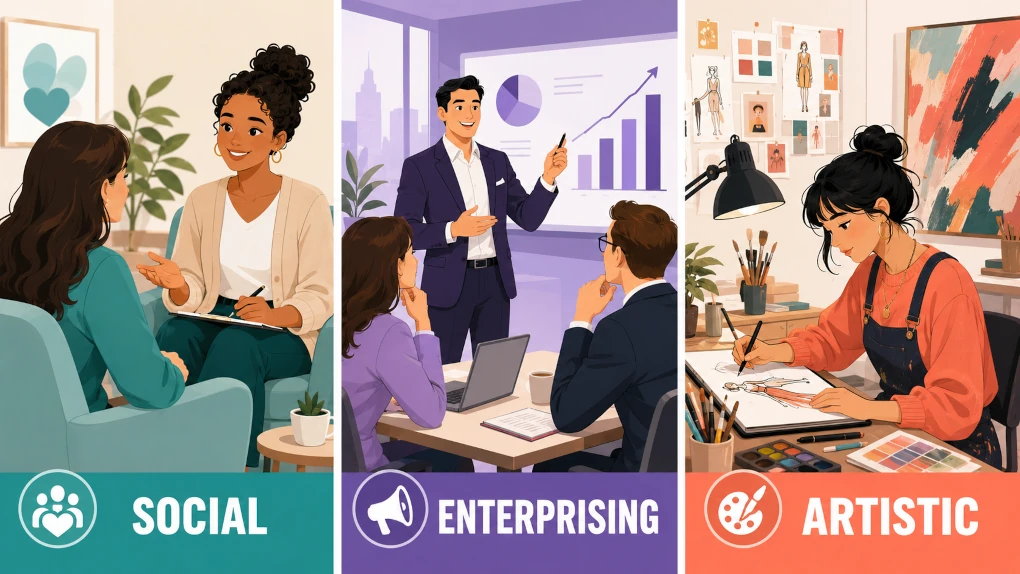
Career paths for people who like people, ideas, and creative influence.
Some people are most engaged when work involves people, communication, creativity, and influence.
They like helping others.
They enjoy sharing ideas.
They want their work to connect with real people.
They often care about expression, meaning, energy, and impact.
In Holland Code terms, that pattern often appears when someone has strong Social, Enterprising, and Artistic interests.
This combination can point toward careers that involve communication, coaching, leadership, persuasion, design, storytelling, teaching, service, advocacy, marketing, or public-facing work.
These individuals may struggle in roles that are too isolated, too repetitive, or too disconnected from people. They usually want their work to matter to someone.
They may enjoy creating something, communicating something, improving someone’s situation, or helping a group move toward a goal.
Understanding the Social, Enterprising, and Artistic Pattern
The Holland model, also known as RIASEC, includes six broad interest areas:
When Social, Enterprising, and Artistic interests appear together, the result is often a person who enjoys people-centered influence.
Each interest adds something different.
Social: The Drive to Help and Connect
Social interests are connected to helping, teaching, coaching, supporting, advising, and improving the lives of others.
People with strong Social interests often enjoy asking:
- Who needs help?
- How can I support this person?
- What would make this easier for them?
- How can I explain this clearly?
- What does this person need from me right now?
They tend to enjoy work that includes conversation, service, guidance, teamwork, and human connection.
Enterprising: The Drive to Lead and Persuade
Enterprising interests are connected to leadership, persuasion, selling, influence, initiative, and moving people toward action.
People with strong Enterprising interests often enjoy asking:
- What are we trying to accomplish?
- Who needs to be involved?
- How do we get people on board?
- What decision needs to be made?
- How do we move this forward?
They tend to enjoy work that includes goals, ownership, communication, negotiation, leadership, and momentum.
Artistic: The Drive to Create and Express
Artistic interests are connected to creativity, originality, design, writing, performance, visual expression, and new ideas.
People with strong Artistic interests often enjoy asking:
- How should this feel?
- What is the message?
- How can we make this more engaging?
- What would make this more original?
- Is there a better way to express this?
They tend to enjoy work that leaves room for creativity, interpretation, style, and personal expression.
What These Three Types Have in Common
Social, Enterprising, and Artistic interests often work well together because they all involve people and communication.
This combination may describe someone who enjoys:
- Helping people understand an idea
- Encouraging others
- Leading a group or project
- Presenting or explaining information
- Creating messages, campaigns, or experiences
- Building relationships
- Influencing decisions
- Teaching or coaching
- Telling stories
- Making work feel more human and engaging
This person may be especially motivated by work that has visible human impact.
They may enjoy seeing how people respond to their ideas.
They may prefer work that includes some variety, interaction, and room for judgment.
They may want more than a task list. They want to understand the purpose behind the work.
Career Fields That Often Fit Social, Enterprising, and Artistic Types
No Holland Code combination guarantees that someone will enjoy or succeed in a specific job.
Skills, experience, education, manager fit, values, and work environment all matter.
But some career fields often align well with this mix of interests.
Marketing, Communications, and Brand Work
Marketing and communications roles can be a strong fit for people who enjoy creativity, persuasion, and audience connection.
Possible career paths include:
- Marketing specialist
- Content marketer
- Social media manager
- Brand strategist
- Public relations specialist
- Communications manager
- Copywriter
- Creative director
- Advertising account manager
- Event marketing specialist
These roles often involve understanding people, shaping messages, creating content, and encouraging action.
The Social side helps you think about the audience.
The Enterprising side helps you focus on goals and results.
The Artistic side helps you create work that feels fresh, clear, and engaging.
Sales, Business Development, and Customer-Facing Roles
Sales and business development roles often appeal to people with strong Enterprising and Social interests, especially when the work involves relationships and problem-solving.
Possible career paths include:
- Account executive
- Business development representative
- Customer success manager
- Sales manager
- Real estate agent
- Insurance broker
- Fundraising specialist
- Client relationship manager
- Partnership manager
- Admissions counselor
These roles often require listening, explaining, persuading, following up, and building trust.
The best fit is usually sales work with a real relationship component. A person with this pattern may not enjoy cold, transactional selling as much as consultative work where they can understand someone’s needs and help them make a good decision.
Human Resources, Talent, and Employee Development
Many HR and talent roles involve a mix of people support, communication, influence, and program design.
Possible career paths include:
- HR generalist
- Talent acquisition specialist
- Recruiter
- Employee experience specialist
- Learning and development specialist
- Training facilitator
- Organizational development specialist
- Career coach
- Onboarding specialist
- People operations manager
These roles may appeal to people who like helping others grow, improving workplace experiences, and communicating ideas clearly.
The Social side supports coaching and employee care.
The Enterprising side supports leadership, recruiting, and change efforts.
The Artistic side supports training design, communication, and creative problem-solving.
Education, Training, and Coaching
Education and coaching roles can be a natural fit for people who enjoy helping others learn and grow.
Possible career paths include:
- Teacher
- Corporate trainer
- Instructional designer
- Academic advisor
- Career counselor
- Student success coach
- Workshop facilitator
- Leadership coach
- Youth program director
- Community education coordinator
These roles often require clear communication, patience, creativity, and the ability to connect ideas to people’s lives.
A person with this Holland pattern may enjoy making learning more engaging and practical. They may also enjoy helping people see possibilities they had not considered before.
Counseling, Advising, and Support Roles
Some Social, Enterprising, and Artistic types are drawn toward work that helps people through personal, educational, or career challenges.
Possible career paths include:
- Counselor
- Social worker
- Case manager
- Mental health program coordinator
- Career advisor
- College admissions advisor
- Life coach
- Nonprofit program coordinator
- Patient advocate
- Community outreach specialist
These roles can involve listening, guiding, encouraging, advocating, and helping people take next steps.
The Artistic side may show up through empathy, intuition, communication, and creative approaches to support.
The Enterprising side may help with advocacy, leadership, and moving people toward action.
Creative Services and Design
Creative roles can be a strong fit when the person wants to make ideas visible, understandable, or emotionally engaging.
Possible career paths include:
- Graphic designer
- UX designer
- Web designer
- Photographer
- Videographer
- Art director
- Creative producer
- Content creator
- Interior designer
- Presentation designer
These roles may appeal to people who enjoy visual communication, storytelling, and shaping how people experience information.
The Social side can help the work stay audience-focused.
The Enterprising side can help connect creative work to business goals.
The Artistic side drives the creative process itself.
Media, Events, and Public-Facing Work
Some people with this pattern enjoy roles where communication happens live, in public, or through shared experiences.
Possible career paths include:
- Event planner
- Community manager
- Public speaker
- Podcast host
- Media producer
- Broadcast journalist
- Fundraising event coordinator
- Trade show manager
- Tourism or hospitality coordinator
- Arts program manager
These roles often require energy, organization, communication, creativity, and comfort with people.
They can be a good fit for someone who enjoys bringing people together around an idea, cause, product, or experience.
Nonprofit, Advocacy, and Community Leadership
Social, Enterprising, and Artistic interests can also point toward mission-driven work.
Possible career paths include:
- Nonprofit program manager
- Community outreach director
- Volunteer coordinator
- Development director
- Advocacy specialist
- Campaign organizer
- Grant writer
- Public policy communicator
- Donor relations manager
- Community engagement specialist
These roles often combine people skills, persuasion, communication, and purpose.
The Social side cares about helping.
The Enterprising side helps move the mission forward.
The Artistic side helps shape the story and connect people emotionally to the cause.
What These Careers Usually Require
Careers that fit Social, Enterprising, and Artistic interests can require very different paths.
Some roles may require a degree.
Some may require a portfolio.
Some may depend heavily on experience, relationships, communication ability, or a track record of results.
Common requirements may include:
- Strong communication skills
- Writing or presentation ability
- Relationship-building skills
- Creativity
- Emotional intelligence
- Leadership ability
- Sales or persuasion skills
- Training or facilitation experience
- Design or content skills
- Industry knowledge
The path depends on the role.
A counselor may need advanced education and licensing.
A designer may need a portfolio.
A sales professional may need product knowledge and a record of performance.
A trainer may need subject-matter expertise and strong facilitation skills.
That is why Holland Codes should be treated as a starting point, not a final answer.
They can help you understand what kind of work may hold your interest. They do not replace the need to understand the actual job.
Work Environments That May Fit Well
People with Social, Enterprising, and Artistic interests may often prefer work environments that are:
- People-oriented
- Communicative
- Creative
- Collaborative
- Purpose-driven
- Flexible enough for ideas
- Active enough to keep things moving
- Open to personal expression
- Connected to a clear audience or mission
They may become frustrated in environments that are too rigid, too isolated, or too focused on routine tasks with little room for communication or creativity.
They may also struggle in roles where the work has no clear human connection.
Potential Strengths of Social, Enterprising, and Artistic Types
This pattern can bring several workplace strengths:
- Communication
- Encouragement
- Creative thinking
- Relationship-building
- Persuasion
- Teaching
- Storytelling
- Leadership
- Adaptability
- Audience awareness
- Emotional insight
- Initiative
These individuals may become the people who help others understand the work, care about the work, and take action.
They often help turn information into a message people can connect with.
Possible Challenges to Watch For
Every interest pattern has trade-offs.
People with strong Social, Enterprising, and Artistic interests may sometimes:
- Lose interest in repetitive tasks
- Resist work that feels too isolated
- Move too quickly from idea to idea
- Depend too much on external feedback
- Struggle with highly detailed administrative work
- Overcommit because they want to help
- Get frustrated when their ideas are ignored
- Prefer the exciting parts of a project over the follow-through
These are not character flaws. They are patterns to understand.
A person with this mix may do their best work when they have enough structure to finish what they start, but enough freedom to bring energy, judgment, and creativity to the work.
Questions to Ask When Exploring Careers
If your Holland Code includes Social, Enterprising, and Artistic interests, consider asking:
- Does this career involve regular interaction with people?
- Will I get to communicate, teach, persuade, or support others?
- Is there room for creativity or personal judgment?
- Does the work connect to a clear audience, customer, student, patient, or community?
- Will I see the human impact of the work?
- Does the role require too much routine detail work for me?
- What kind of follow-through does this career demand?
- What education, portfolio, license, or experience is required?
- What does a normal day actually look like?
- Would I enjoy the daily work after the novelty wears off?
That last question matters.
Some careers sound exciting from the outside. The daily work may tell a different story.
Career Fit Is About More Than One Code
Holland Codes can help you explore career fit, but they are only part of the picture.
Two people may both have Social, Enterprising, and Artistic interests and still prefer very different roles depending on their DISC style, 16 Personality type, values, education, and life circumstances.
For example:
- A person with a more assertive DISC style may enjoy sales leadership, recruiting, or entrepreneurship.
- A person with a steadier style may prefer counseling, coaching, or employee support.
- A person with strong analytical traits may enjoy marketing strategy, UX research, or organizational development.
- A person who needs creative freedom may prefer design, content, media, or independent consulting.
The Holland Code points toward the kinds of work that may be engaging.
Other personality and behavioral factors help explain how someone may want to do that work.
Learn more about how different assessment frameworks work together in Why Personality Assessments Are More Useful Together Than Alone.
Final Thoughts
People with Social, Enterprising, and Artistic interests often enjoy work that involves people, communication, creativity, and influence.
They may be drawn to careers where they can help others, lead conversations, shape ideas, create messages, support growth, or move people toward action.
That can include careers in marketing, sales, HR, education, coaching, counseling, design, media, events, nonprofit work, and community leadership.
The best career path is not simply the one that matches a code.
It is the one where the daily work, environment, expectations, and growth path fit the whole person.
Holland Codes provide a useful starting point for that exploration.
Explore the complete Personality Types Explained series.
Frequently Asked Questions
What careers are best for Social, Enterprising, and Artistic Holland types?
Careers that often fit this pattern include marketing, communications, sales, human resources, recruiting, training, coaching, counseling, design, media, events, nonprofit work, and community leadership. These fields often involve people, communication, creativity, and influence.
What does a Social, Enterprising, and Artistic Holland Code mean?
This combination often describes someone who enjoys helping people, sharing ideas, leading conversations, creating messages, and influencing action. They may prefer work that includes human connection, creative expression, communication, and visible impact.
Is SEA or SAE a good Holland Code for marketing careers?
Yes. Social, Enterprising, and Artistic interests can align well with many marketing roles because marketing often combines audience understanding, persuasion, creativity, communication, and business goals. The best fit depends on the specific role and daily work.
Are Social and Enterprising types good for sales careers?
They can be. Enterprising interests often support persuasion, leadership, and goal-oriented work. Social interests can support listening, trust-building, and consultative selling. Many people with this combination prefer relationship-based sales over purely transactional selling.
Can Social, Enterprising, and Artistic types work in HR?
Yes. This pattern can fit many HR, recruiting, talent development, employee experience, and learning roles. These careers often involve communication, coaching, program design, relationship-building, and helping people succeed at work.
Do Holland Codes determine the right career?
No. Holland Codes are a starting point for career exploration. They do not determine the right career by themselves. Skills, education, experience, values, personality, lifestyle goals, and the daily reality of the job all matter.
What should I ask before choosing a career based on my Holland Code?
Useful questions include: What does a normal day look like? Does the work involve people? Is there room for creativity? What kind of follow-through does the role require? What training or portfolio is needed? Would I still enjoy the work after the novelty wears off?
Hire Better and
Manage Smarter
We combine 3 proven, established assessments into one, giving you the most comprehensive view of a person.
Are you seeking an assessment for personal use? Click Here