
Personality Types Explained Series: DISC • Holland • 16 Personalities
16 Personality Types Explained
Traditionalists, Experiencers, Idealists, and Conceptualizers at Work
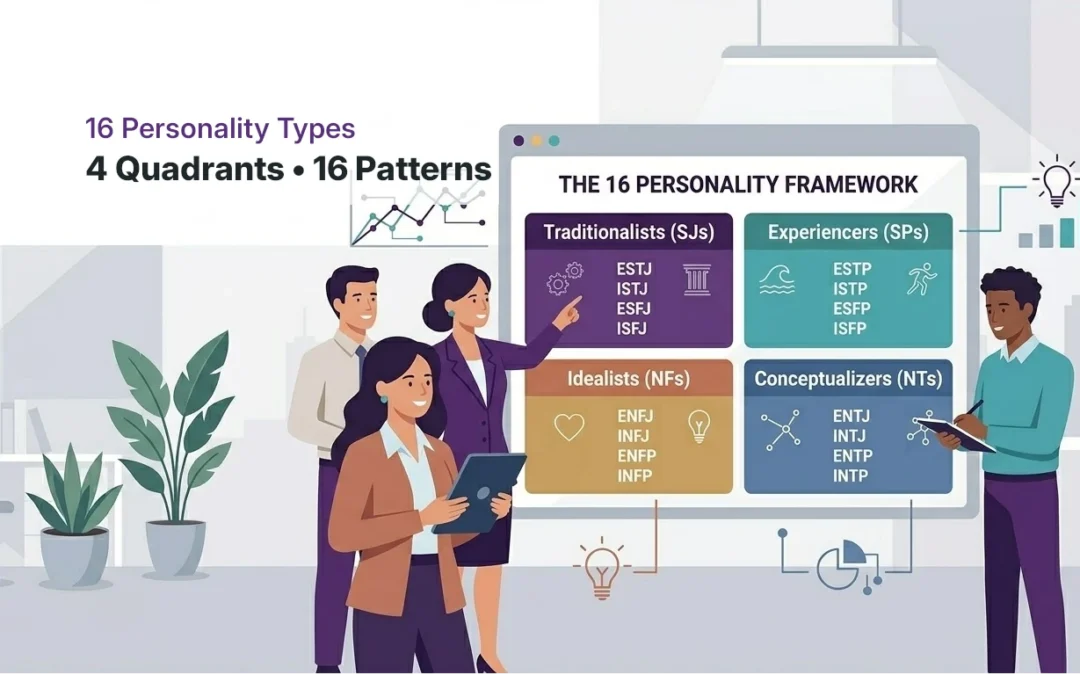
The 16 personality types describe how people tend to focus attention, process information, make decisions, and approach structure. In the Talent Insights platform, these 16 types are grouped into four broader quadrants: Traditionalists (SJs), Experiencers (SPs), Idealists (NFs), and Conceptualizers (NTs). Together, these patterns help explain work style, communication, motivation, and career tendencies.
The 16 personality framework is widely used for personal development, communication insight, leadership awareness, and career exploration. While each of the 16 types has its own distinct pattern, the four quadrants make it easier to understand the broader themes that connect similar personalities.
This page serves as the main hub for the 16 Personality Types section of the series. As the library expands, it will link to each quadrant page and each individual personality type page.
What Are the 16 Personality Types?
The 16 personality types are formed from four preference pairs that describe how people tend to:
- focus attention and energy
- take in information
- make decisions
- approach structure and planning
In practical terms, these types help explain why some people are more strategic, relational, spontaneous, methodical, analytical, or service-oriented than others.
Rather than treating every type as completely separate, Talent Insights groups them into four broader categories that make the framework easier to understand at a glance.
Quick Summary of the Four Quadrants
| Quadrant | Type Group | Benchmark Role | Core Theme |
| Traditionalists | SJs | Stabilizers | Practical, decisive, dependable |
| Experiencers | SPs | Improvisers | Responsive, spontaneous, action-oriented |
| Idealists | NFs | Catalysts | Relational, growth-oriented, values-driven |
| Conceptualizers | NTs | Strategists | Intellectual, strategic, competent |
In the Talent Insights Benchmark tool, these same quadrants are sometimes described as Stabilizers, Improvisers, Catalysts, and Strategists to emphasize the role each group often plays on a team.
Why the Quadrants Matter
The full set of 16 types can feel overwhelming at first. The four quadrants simplify the framework by grouping related types together based on shared tendencies.
This is especially useful in workplace settings, where leaders and employees often want to understand:
- how someone communicates
- what kind of work environment they prefer
- how they make decisions
- what motivates them
- how they are likely to contribute on a team
The quadrant pages help answer those broader questions before diving into the details of each individual type.
Traditionalists (SJs)
Traditionalists are often practical, dependable, and decisive. They typically value responsibility, structure, consistency, and doing what needs to be done. In work settings, they are often seen as reliable, organized, and committed to stable systems and clear expectations.
Explore the Traditionalists (SJs)
Traditionalist Types
A structured, decisive type often associated with leadership, responsibility, and practical organization.
A dependable, detail-oriented type known for consistency, thoroughness, and duty.
A relational and service-oriented type focused on people, support, and practical care.
A loyal, steady, and thoughtful type often associated with reliability, support, and careful follow-through.
Experiencers (SPs)
Experiencers are often responsive, spontaneous, and action-oriented. They tend to adapt quickly, live in the moment, and respond well to fast-changing environments. At work, they are often practical problem-solvers who prefer action over excessive theory.
Explore the Experiencers (SPs)
Experiencer Types
An energetic, action-oriented type often associated with confidence, adaptability, and fast decisions.
A calm, hands-on type known for practical problem-solving and technical competence.
An engaging, spontaneous type often associated with enthusiasm, responsiveness, and social energy.
A gentle, adaptable type often recognized for personal values, creativity, and practical responsiveness.
Idealists (NFs)
Idealists are often relational, growth-oriented, and values-driven. They tend to care deeply about meaning, development, and helping people reach their potential. In the workplace, they are often drawn to communication, coaching, service, and mission-driven work.
Idealist Types
A relational leadership type often associated with encouragement, influence, and growth in others.
An insightful and purpose-driven type known for depth, empathy, and long-range vision.
An energetic and growth-oriented type often recognized for creativity, enthusiasm, and people focus.
A reflective and values-centered type often associated with meaning, empathy, and authenticity.
Conceptualizers (NTs)
Conceptualizers are often intellectual, strategic, and competent. They tend to enjoy systems, ideas, innovation, and solving complex problems. At work, they are often drawn to strategy, analysis, design, and long-range thinking.
Explore the Conceptualizers (NTs)
Conceptualizer Types
A strategic and decisive type often associated with leadership, systems thinking, and execution.
An independent and strategic type known for planning, analysis, and long-range problem solving.
An inventive and idea-driven type often associated with innovation, debate, and conceptual exploration.
A highly analytical and conceptual type often recognized for logic, theory, and intellectual depth.
How the 16 Personality Types Help at Work
The 16 personality framework can help people better understand how they prefer to communicate, solve problems, relate to others, and approach structure.
That can be valuable in workplace situations such as:
- team communication
- leadership development
- career planning
- role fit
- conflict reduction
- coaching and employee growth
When used thoughtfully, the framework helps people see that different personalities bring different strengths rather than assuming there is only one right way to work.
How Talent Insights Uses the 16 Personality Framework
The Talent Insights MAP assessment includes 16 personality patterns alongside DISC behavioral tendencies and Holland occupational interests to provide a more complete understanding of how people work.
Within MAP, the 16 personality framework helps illuminate patterns related to:
- communication preferences
- decision-making tendencies
- motivation and values
- planning and structure
- team contribution style
Using multiple frameworks together helps create a richer and more practical picture than relying on any single model alone.
Frequently Asked Questions
What are the 16 personality types?
The 16 personality types are personality patterns built from four preference pairs that describe how people tend to focus attention, process information, make decisions, and approach structure.
What are the four quadrants of the 16 personality types?
In the Talent Insights platform, the four quadrants are Traditionalists (SJs), Experiencers (SPs), Idealists (NFs), and Conceptualizers (NTs).
Why group the 16 types into quadrants?
The quadrants make the system easier to understand by grouping related types that share broader patterns in motivation, communication, and work style.
Can the 16 personality types help with career planning?
Yes. The framework can support career exploration by helping people better understand their preferences, strengths, and likely work environment fit.
Hire Better and
Manage Smarter
We combine 3 proven, established assessments into one, giving you the most comprehensive view of a person.
Are you seeking an assessment for personal use? Click Here