
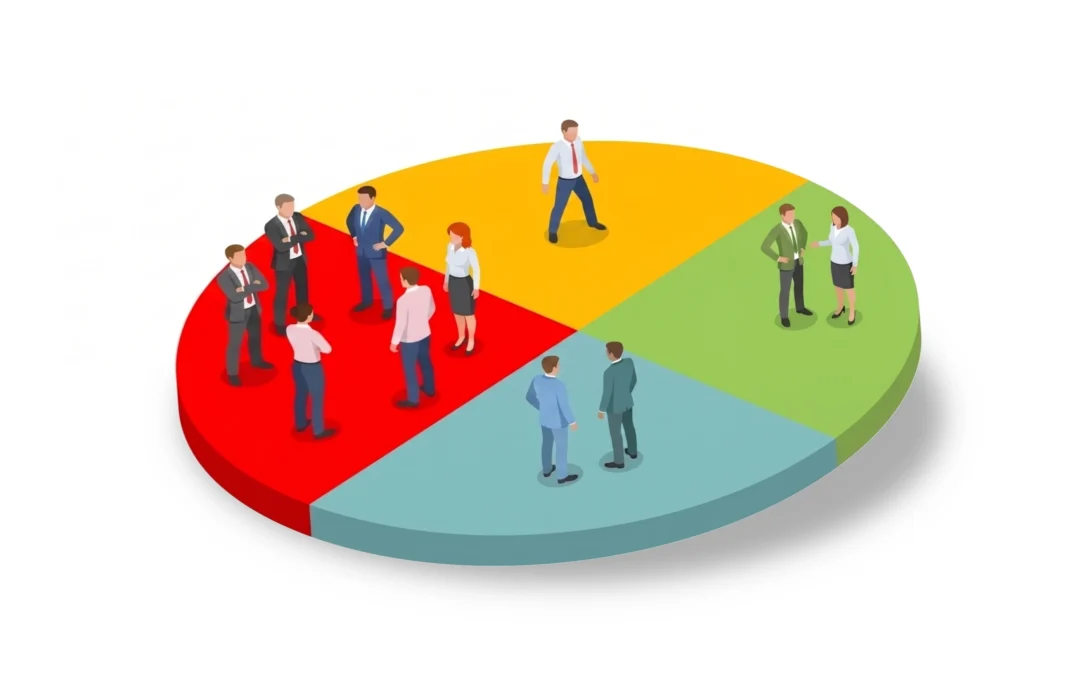
Walk into enough leadership meetings and you start noticing that teams develop personalities of their own.
Not official personalities. Nobody writes them down. But they’re there.
Some teams move at a blistering pace. People interrupt each other constantly, ideas get challenged in real time, and decisions happen before everyone has fully processed the conversation. Oddly enough, some groups thrive in that environment.
Other teams feel almost cautious by comparison. More discussion. More context. More concern about how decisions land with people.
Neither one is automatically healthier.
But if you spend enough time around leadership teams, you start recognizing that those patterns don’t appear out of thin air. A lot of the time, they emerge from the personalities and communication styles most represented in the room.
That’s where the idea of cultural gravity starts becoming useful.
Every team drifts toward certain habits.
Certain communication styles start feeling normal. Certain behaviors get rewarded without anyone formally saying so. Some perspectives naturally dominate discussions while others slowly fade into the background.
Eventually the team stops noticing the pattern because the pattern simply becomes “how we operate.”
One leadership team we worked with recently made this especially obvious.
On paper, it was a very capable group. Experienced leaders. Strong operators. The sort of team most organizations would trust with major decisions.
But there was tension underneath the surface.
Some team members described the culture as refreshingly direct. Others experienced the same conversations as unusually intense.
One leader in particular had a military background and communicated very bluntly. That initially seemed like the obvious explanation. But once we stepped back and looked at the broader assessment patterns, the picture became much more interesting.
The issue wasn’t really one person.
The entire team had developed a strong communication gravity around directness, decisiveness, accountability, and fast-moving problem solving.
Once you could see that pattern clearly, a lot of the interpersonal friction suddenly made more sense.
Teams Quietly Train People On How To Behave
This is the part leaders often underestimate.
Culture isn’t shaped only by mission statements or leadership philosophy. Day to day, teams teach people how to behave through repetition.
How fast discussions move. Whether disagreement is welcomed or avoided. Whether people are rewarded for caution or decisiveness. Whether someone gets praised for asking hard questions — or quietly learns to stop raising them.
Most of this happens informally.
Over time, teams start developing shared instincts.
In the leadership group we analyzed, the DISC patterns stood out almost immediately. There was a heavy concentration of Dominant behavioral styles.
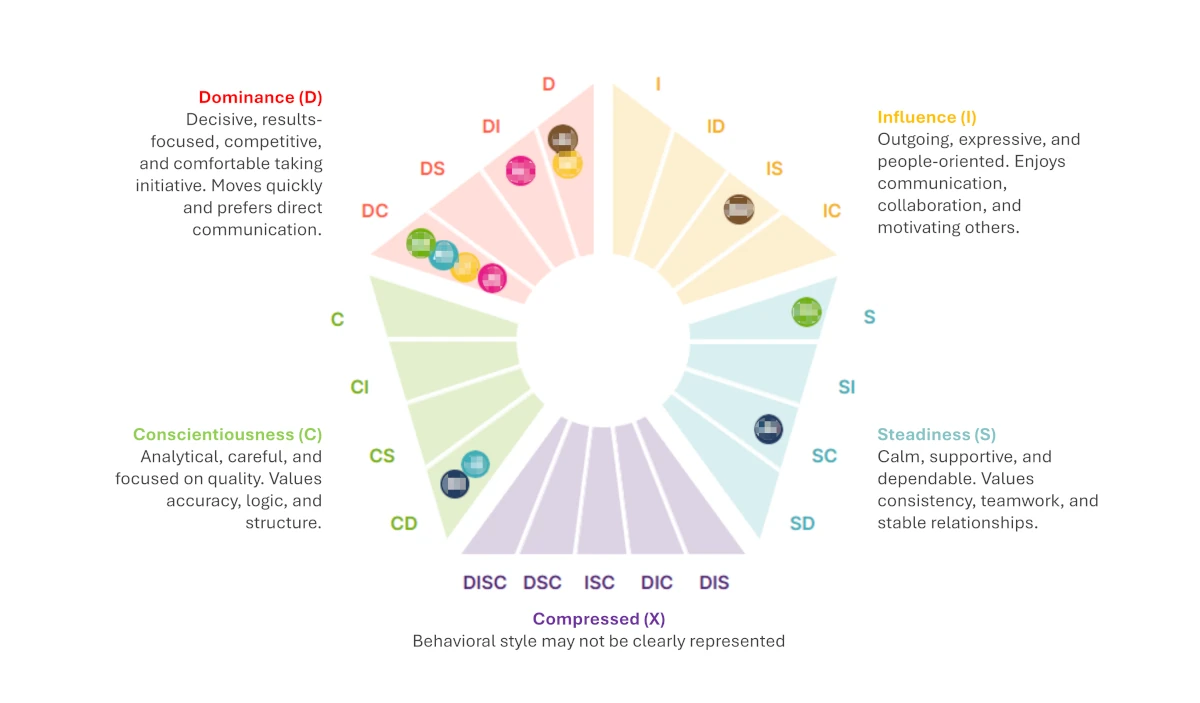
That explained quite a bit.
Teams with strong D-style representation often value:
- speed,
- direct communication,
- challenge-oriented discussion,
- visible accountability,
- and making decisions quickly.
There are real advantages to that.
Meetings rarely stall. Difficult conversations usually happen instead of getting buried under politeness. Problems get addressed.
Honestly, plenty of organizations would benefit from a little more of that energy.
But there’s a flip side.
At a certain point, some meetings probably stopped feeling like collaborative problem-solving and started feeling more like intellectual sparring. Nobody intended that. But you could see how the tone of the room might slowly drift there over time.
People who needed a little more processing time before responding may have started participating less. Someone who preferred more collaborative discussion may have quietly decided it wasn’t worth fighting for airtime.
That’s how cultural gravity works.
Not dramatically. Gradually.
And because the behavior becomes normal inside the group, people often interpret the resulting friction personally.
One person thinks: “We’re just being efficient.”
Another thinks: “Why does every disagreement feel like a competition?”
Meanwhile, both people may actually be reacting to the same underlying communication culture.
The Team Wasn’t Just Direct — It Was Structured Around Logic
The Work Approach section inside Team Insights added another layer to the picture.
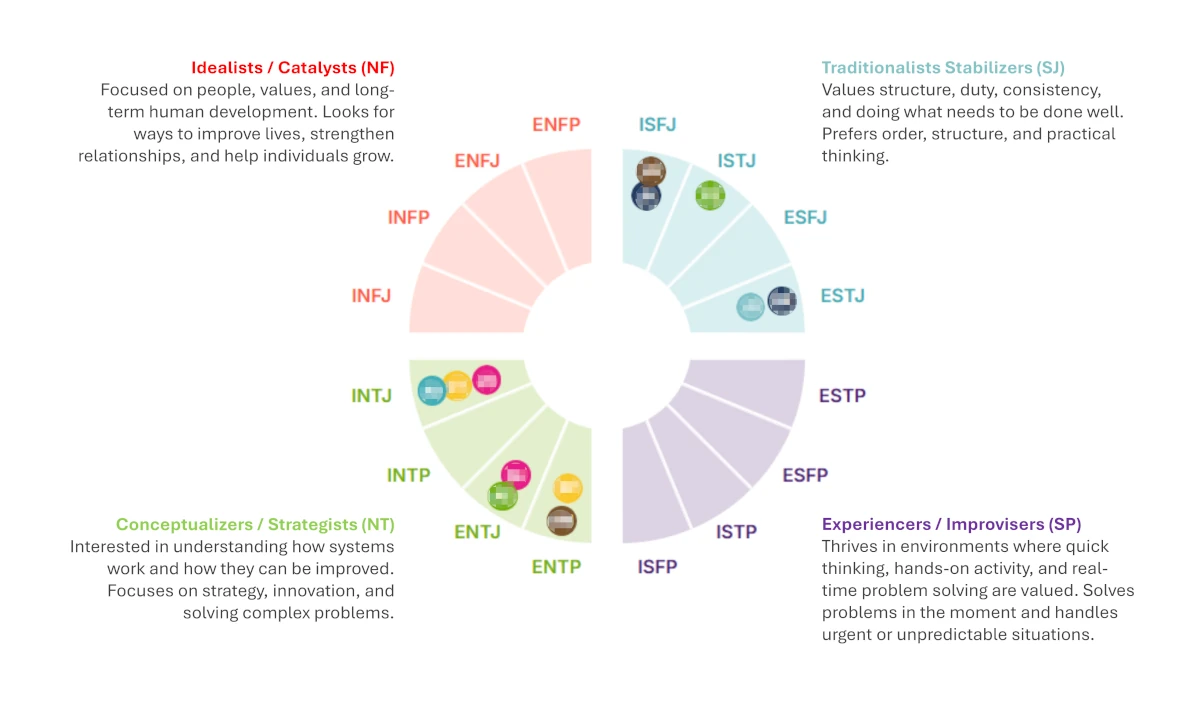
This team showed a strong concentration of strategic and stabilizing personality groups.
You could feel that in the way decisions were discussed.
The room naturally gravitated toward:
- logic,
- operational thinking,
- structure,
- execution,
- and practical next steps.
Again, there’s nothing inherently wrong with that. In many industries, that kind of culture is incredibly effective.
These are often the teams that can handle complexity without panicking. The groups that can untangle operational messes while everyone else is still debating whose fault something was.
But every concentrated strength creates tradeoffs.
You can almost picture the meeting. Someone raises a concern about morale, communication, or buy-in, there’s a brief acknowledgment, and then the room snaps back toward timelines, execution, and next steps.
Not because people don’t care.
The team’s instincts simply pull conversations back toward solving the problem.
That distinction matters.
Leaders sometimes assume interpersonal tension means people have bad intentions or poor emotional intelligence. A lot of the time, it’s more mechanical than that.
The communication culture itself is reinforcing certain behaviors over others.
The Work People Enjoy Shapes Culture Too
One of the more interesting parts of this project involved the Holland Code distributions.
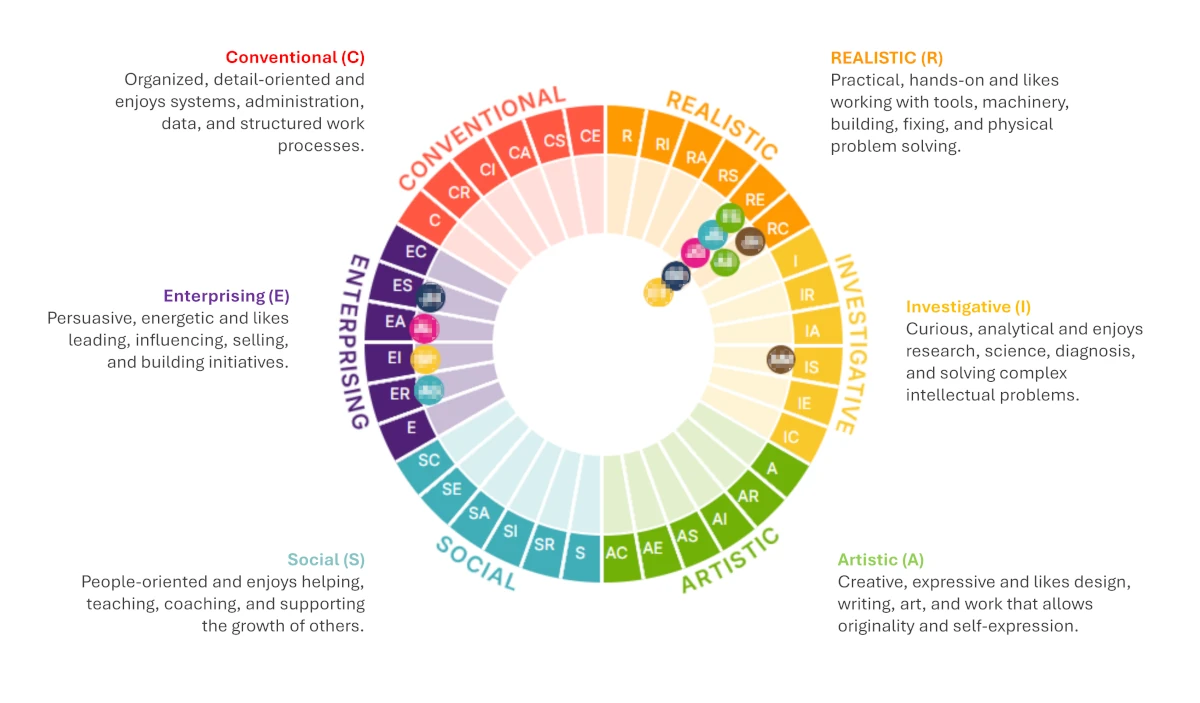
The leadership team leaned heavily toward Realistic and Enterprising tendencies.
In plain English, this was a group that generally enjoyed:
- solving concrete problems,
- taking initiative,
- building momentum,
- fixing things,
- and driving visible progress.
You could imagine them getting restless in meetings that drifted too far into abstract theorizing.
And honestly, that’s probably one reason the team had been successful.
Action-oriented cultures get things done.
But they also tend to move quickly.
Sometimes too quickly.
One thing we noticed while discussing the team dynamics was how easily operational concerns could overshadow relational ones.
A communication issue might get acknowledged briefly before the group pivoted back toward execution.
Someone wanting more discussion could unintentionally come across as slowing progress.
Again, nobody was trying to create that dynamic.
That’s what made the conversation interesting.
Once the leadership team started seeing these patterns visually, the discussion became far less personal.
Instead of: “Why is this person so blunt?”
The conversation shifted toward: “What kind of communication culture has this team gradually built together?”
That’s a much healthier discussion.
One Question Ended Up Explaining A Lot
The Custom Questions feature inside Team Insights turned out to be surprisingly useful during this process.
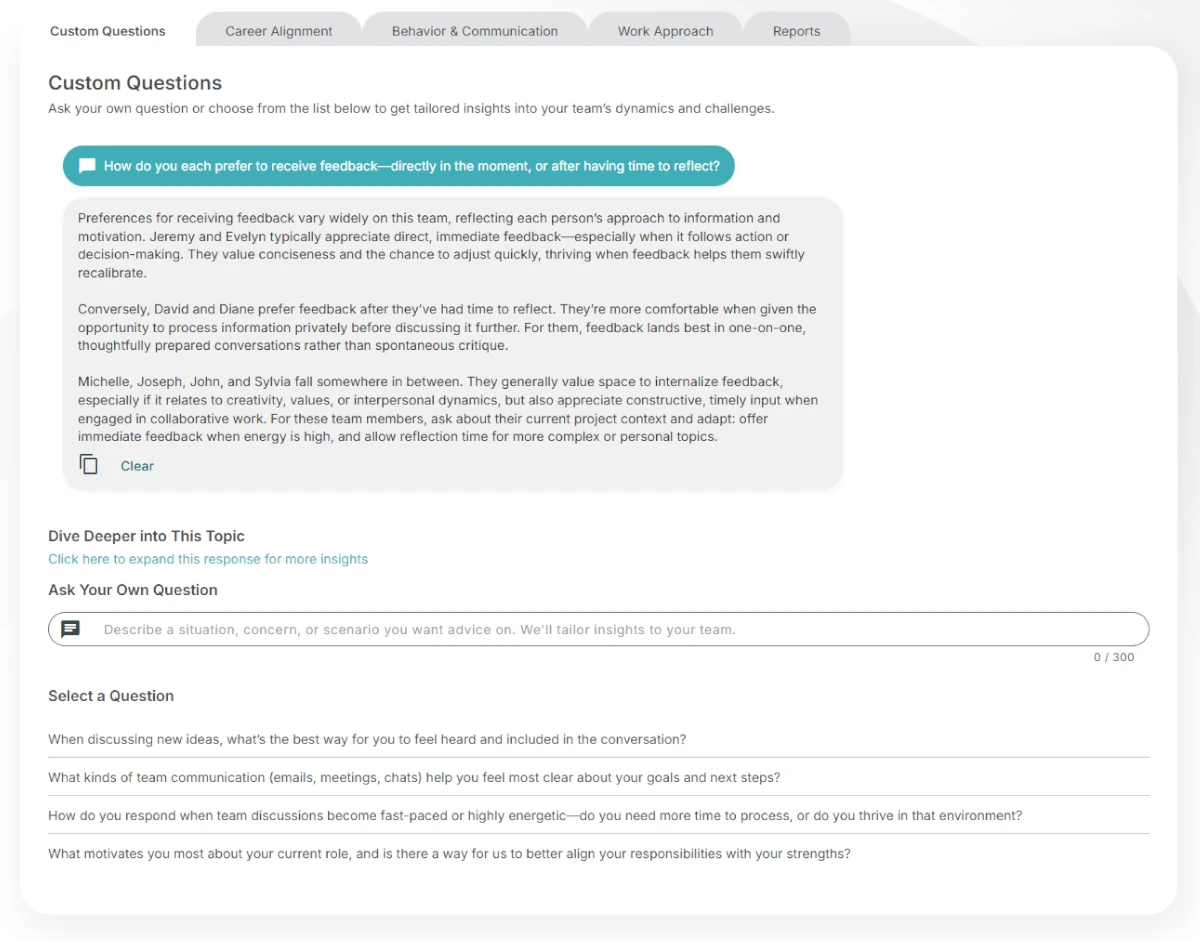
One question in particular generated a much deeper discussion than anyone expected:
“How do you each prefer to receive feedback — directly in the moment, or after having time to reflect?”
Simple question.
But the responses immediately exposed a communication mismatch that had probably existed for a long time.
Some team members genuinely appreciated immediate feedback. To them, direct feedback felt respectful because it was clear and efficient.
Others preferred time to process before responding thoughtfully.
Neither side was wrong.
But once you realize those preferences exist simultaneously inside the same leadership group, a lot of interpersonal tension suddenly becomes easier to interpret.
One person walks away thinking: “I’m being straightforward.”
Another walks away thinking: “That conversation felt harsher than it needed to be.”
Neither person necessarily understands why the other reacted that way.
That’s where these kinds of tools become genuinely practical.
They don’t magically solve conflict.
They simply give teams language for discussing patterns that were already happening anyway.
Similarity Creates Momentum — And Watchouts
Leadership teams often talk about diversity in terms of demographics or background.
But behavioral similarity matters too.
When an entire team leans heavily toward speed, decisiveness, operational thinking, and direct communication, those tendencies gradually start reinforcing each other.
The culture builds momentum around them.
That can create tremendous strengths:
- fast alignment,
- clear accountability,
- strong execution,
- less political maneuvering,
- and greater willingness to address difficult issues directly.
But the same momentum can also create pressure points if nobody notices what’s becoming underrepresented.
Challenge can slowly become competition. Fast decisions can reduce buy-in. Some people may stop voicing concerns because they don’t feel like there’s enough room to process ideas collaboratively.
None of this means the culture is unhealthy.
It simply means leadership teams, like individuals, have tendencies.
And unmanaged tendencies tend to intensify over time.
What Healthy Teams Usually Figure Out
The healthiest teams aren’t necessarily the most balanced on paper.
Some very successful leadership groups are heavily concentrated in particular styles.
What usually separates healthy cultures from unhealthy ones is whether the team understands its own patterns.
Healthy teams notice when discussions are moving too fast.
They recognize when challenge starts sounding combative instead of constructive.
They understand which perspectives naturally dominate the room and which ones may need more intentional invitation.
Sometimes the adjustments are surprisingly small.
- Clarifying whether a meeting is exploratory or decisional.
- Pausing before finalizing a high-impact decision.
- Actively inviting quieter perspectives.
- Recognizing that not everyone processes information at the same speed.
- Separating disagreement from personal criticism.
Those aren’t massive organizational overhauls.
But they can dramatically change how a leadership culture feels over time.
Final Thoughts
Every team develops habits.
Ways of communicating. Ways of handling disagreement. Ways of rewarding certain behaviors while unintentionally discouraging others.
Eventually those habits stop feeling like habits and start feeling like “just how this team works.”
That’s why visualizing these patterns can be so useful.
Most teams don’t need artificial balance or a personality label for every situation.
What leaders usually need is visibility.
A clearer understanding of the behavioral and communication patterns already shaping the culture — especially the ones nobody notices anymore because they’ve become normal.
Once you can see those patterns clearly, you start gaining a little more control over where the culture goes next.
See Your Team’s Communication Patterns More Clearly
Talent Insights Team Insights helps leaders visualize how personality, behavior, and work preferences shape team communication, collaboration, and decision-making.
Frequently Asked Questions
What is cultural gravity in a team?
Cultural gravity is the natural pull a team develops toward certain communication styles, decision-making habits, and behavioral norms. It is shaped by leadership, history, expectations, and the personality patterns most represented within the group.
How can personality data help leaders understand team culture?
Personality data can help leaders see patterns that may otherwise go unnoticed, such as how a team handles disagreement, how quickly it makes decisions, what types of communication feel normal, and which perspectives may be underrepresented.
Does Team Insights diagnose team problems?
No. Team Insights is not a diagnostic or clinical tool. It is designed to help leaders better understand communication, behavior, work preferences, and collaboration patterns so they can guide team dynamics more intentionally.
Can a team have too much similarity?
Similarity can create real strengths, such as speed, cohesion, and shared expectations. It can also create watchouts if the team unintentionally underrepresents certain perspectives or communication needs.
How can leaders use Team Insights?
Leaders can use Team Insights to support team development, improve communication, guide leadership discussions, reduce friction, and identify practical ways to help different team members work together more effectively.
Hire Better and
Manage Smarter
We combine 3 proven, established assessments into one, giving you the most comprehensive view of a person.
Are you seeking an assessment for personal use? Click Here