
One of the biggest mistakes organizations make with personality assessments is expecting a single system to explain everything about a person.
But people are more complex than that.
Different personality frameworks tend to measure different dimensions of how people work, communicate, and make decisions.
That’s why at Talent Insights, we combine multiple assessment systems together instead of relying on just one.
Because when used responsibly, multiple perspectives often create a much more useful understanding than any single framework alone.
Different Assessments Answer Different Questions
One of the simplest ways to understand this is to recognize that each assessment is focused on a different part of a person’s overall personality.
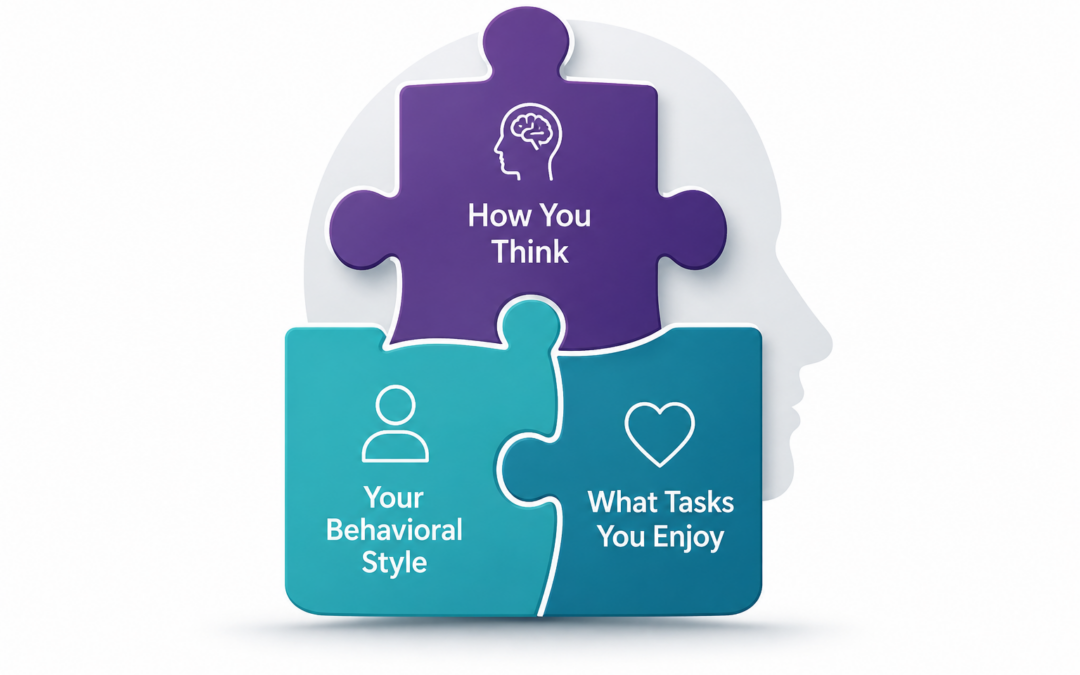
At Talent Insights, we generally think about the three systems this way:
- Holland Code: The type of work you enjoy
- DISC: Your behavioral style
- 16 Personalities: How you think
None of these systems are trying to measure exactly the same thing.
And that’s precisely why combining them can be so valuable.
Holland Code: The Type of Work You Enjoy
Holland Code focuses primarily on motivational fit and work preferences.
It helps identify the kinds of environments and activities that people are naturally drawn toward.
For example:
- Some people are energized by analytical problem solving
- Some enjoy creative and expressive work
- Others prefer highly structured and detail-oriented environments
- And some are most motivated by working directly with people
Understanding work preferences can be extremely valuable because people often perform best in environments that naturally align with what energizes them.
Two people may behave similarly on the surface while being motivated by completely different types of work internally.
DISC: Your Behavioral Style
DISC focuses more heavily on observable workplace behavior and communication style.
It helps answer questions like:
- How direct or cautious is this person?
- How quickly do they tend to make decisions?
- How do they communicate with others?
- Do they prefer structure or flexibility?
This becomes especially useful in hiring, leadership, and team communication.
For example, a highly dominant personality may naturally communicate very differently from someone who is more patient, reserved, or detail-focused.
Neither style is inherently better.
But understanding those behavioral tendencies can help organizations improve communication, reduce friction, and better align people with roles.
16 Personalities: How You Think
16 Personalities focuses more heavily on cognition and decision-making patterns.
It helps provide insight into how people process information and approach the world mentally.
For example:
- Some people focus more on immediate realities and practical details
- Others naturally think in terms of future possibilities and abstract ideas
- Some make decisions primarily through logic and systems
- Others place greater emphasis on people and values
This layer can often help explain why two people with similar behavioral styles may still approach problems very differently internally.
Together, They Reveal the “Shape” of Personality
Individually, each system provides useful information.
But together, they often create a much more complete picture.
At Talent Insights, we often describe this as revealing the overall “shape” of a person’s personality.
For example, someone might:
- Enjoy highly analytical work
- Communicate in a very direct and fast-paced way
- Think strategically and focus on long-term systems
Meanwhile, another person might:
- Enjoy highly social and collaborative work
- Communicate more patiently and supportively
- Think more relationally and people-first
Neither profile is automatically better.
But they may thrive in very different roles, environments, and team structures.
The Shape of a Team’s Culture
This concept becomes even more useful at the team level.
When multiple employees complete assessments, patterns often begin to emerge.
You can start to see the broader “shape” of a team’s culture.
For example:
- Some teams may skew highly competitive and fast-moving
- Others may be highly analytical and detail-oriented
- Some may be highly relationship-focused and collaborative
- Others may strongly value structure, stability, and process
None of these cultures are inherently right or wrong.
But understanding those patterns can help leaders make more informed decisions about hiring, communication, team structure, and management strategy.
Personality Assessments Should Support Decisions — Not Replace Them
It’s also important to recognize what personality assessments cannot do.
No assessment can perfectly predict performance, character, intelligence, or future success.
Personality assessments should never replace interviews, experience evaluation, reference checks, or leadership judgment.
Instead, they work best as decision-support tools.
Used responsibly, they can help reduce blind spots and provide additional context that may not be obvious from a resume or interview alone.
Why Talent Insights Combines Multiple Systems
At Talent Insights, we combine DISC, Holland Code, and 16 Personalities because we believe each framework contributes a different perspective.
Together, they create a more practical and useful understanding of how people are likely to operate within real-world workplace environments.
And importantly, our goal is not just generating reports.
We also provide practical tools that help organizations apply those insights in hiring and management situations, including:
- Candidate comparison tools
- Benchmarking tools
- Structured interview guides
- Interaction and communication guides
- Team analysis tools
The goal is not personality theory for its own sake.
The goal is helping organizations make more informed decisions about people.
Final Thoughts
No personality assessment can fully explain a human being.
But when multiple frameworks are combined thoughtfully and used responsibly, they can provide valuable insight into:
- The type of work people enjoy
- How they behave and communicate
- How they think and make decisions
And together, those perspectives can help reveal the broader shape of both individuals and teams.
That understanding can be extremely valuable in hiring, leadership, communication, and long-term team development.
Frequently Asked Questions
Why combine multiple personality assessments?
Different personality assessments measure different aspects of how people work. Combining systems like DISC, Holland Code, and 16 Personalities can create a more complete understanding of work preferences, behavioral style, and decision-making patterns.
What does Holland Code measure?
Holland Code focuses primarily on the type of work people naturally enjoy and the environments they are most motivated by. It helps identify work preferences and motivational fit.
What does DISC measure?
DISC focuses on behavioral style and communication tendencies. It helps explain how people typically communicate, make decisions, and respond to workplace situations.
What does the 16 Personalities assessment measure?
16 Personalities focuses more heavily on cognition and decision-making patterns. It helps provide insight into how people process information, evaluate decisions, and approach the world mentally.
Can personality assessments predict job performance?
No personality assessment can perfectly predict future performance or success. Personality assessments work best as decision-support tools used alongside interviews, experience evaluation, references, and leadership judgment.
How can personality assessments help with team management?
Personality assessments can help leaders better understand communication styles, motivational differences, and team dynamics. This can improve communication, reduce friction, and support more effective team development.
Why does Talent Insights combine DISC, Holland Code, and 16 Personalities?
Talent Insights combines multiple systems because each framework measures a different aspect of personality. Together, they help create a more complete and practical understanding of how people work, communicate, and make decisions.
Hire Better and
Manage Smarter
We combine 3 proven, established assessments into one, giving you the most comprehensive view of a person.
Are you seeking an assessment for personal use? Click Here