
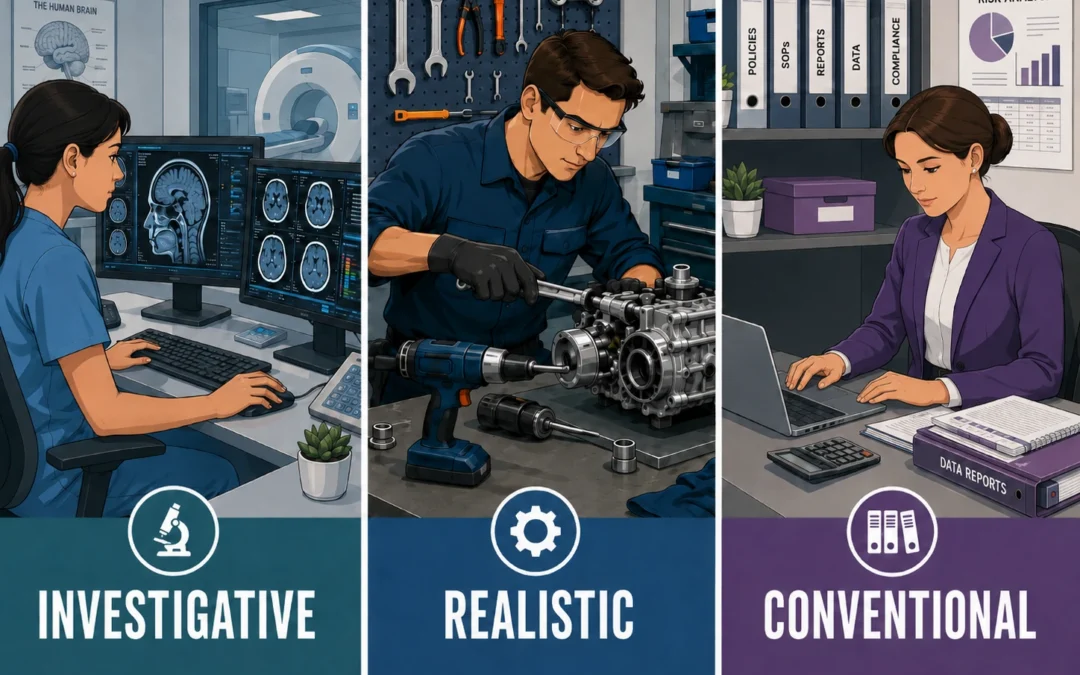
Career paths for people who like solving practical problems with accuracy and structure.
Some people are most engaged when work is practical, analytical, and well-organized.
They like understanding how things work.
They prefer clear standards.
They enjoy solving problems that have real-world consequences.
They often want their work to produce something useful, measurable, or dependable.
In Holland Code terms, that pattern often appears when someone has strong Investigative, Realistic, and Conventional interests.
This combination can point toward careers that involve technical problem-solving, systems, tools, data, quality, documentation, compliance, diagnostics, or applied analysis.
These individuals may not be satisfied by work that is purely abstract, purely social, or too loosely defined. They often want to understand the problem, work with real information, follow a reliable process, and produce an accurate result.
Understanding the Investigative, Realistic, and Conventional Pattern
The Holland model, also known as RIASEC, includes six broad interest areas:
When Investigative, Realistic, and Conventional interests appear together, the result is often a person who enjoys practical analysis.
Each interest contributes something different.
Investigative: The Drive to Understand
Investigative interests are connected to analysis, research, diagnosis, logic, and problem-solving.
People with strong Investigative interests often enjoy asking:
- What is really happening here?
- What caused this issue?
- What does the data show?
- How can we test or verify the answer?
- What pattern are we missing?
They tend to enjoy work that requires curiosity, precision, and independent thinking.
Realistic: The Need for Practical Application
Realistic interests are connected to tools, equipment, hands-on work, physical systems, mechanics, technology, and tangible outcomes.
People with strong Realistic interests often enjoy asking:
- How does this work?
- What needs to be built, repaired, tested, or improved?
- What is the practical solution?
- What can I do with my hands or technical skill?
- What result can be seen, measured, or used?
They tend to prefer work that is concrete and grounded in real-world application.
Conventional: The Preference for Structure and Accuracy
Conventional interests are connected to organization, documentation, systems, procedures, data, compliance, and detail-oriented work.
People with strong Conventional interests often enjoy asking:
- What is the correct process?
- Has this been documented?
- Are the details accurate?
- Are we following the right standard?
- How can we make this more consistent?
They tend to value structure, reliability, and clearly defined expectations.
What These Three Types Have in Common
Investigative, Realistic, and Conventional interests often work well together because they all support dependable problem-solving.
This combination may describe someone who enjoys:
- Diagnosing practical problems
- Working with tools, systems, equipment, or data
- Understanding technical details
- Following defined procedures
- Improving accuracy and efficiency
- Testing assumptions
- Documenting results
- Finding errors before they become larger problems
- Producing work that is useful and reliable
This person may be especially motivated by roles where accuracy matters and the work has visible consequences.
They may enjoy solving a problem more than discussing it endlessly.
They may prefer evidence over opinion.
They may appreciate clear expectations, but still want enough intellectual challenge to stay engaged.
Career Fields That Often Fit Investigative, Realistic, and Conventional Types
No Holland Code combination guarantees that a person will enjoy or succeed in a specific job.
Skills, experience, education, work environment, manager fit, and personal values all matter.
But certain career fields often align well with this combination of interests.
Engineering and Technical Design
Engineering-related roles often appeal to people with Investigative, Realistic, and Conventional interests because they combine analysis, practical application, and standards.
Possible career paths include:
- Mechanical engineer
- Electrical engineer
- Civil engineer
- Manufacturing engineer
- Industrial engineer
- Quality engineer
- Process engineer
- CAD technician
- Engineering technician
- Product testing technician
These careers may involve understanding systems, solving technical problems, improving processes, testing designs, or ensuring that products meet requirements.
The Investigative side enjoys analysis and problem-solving.
The Realistic side enjoys tangible systems and applied work.
The Conventional side values accuracy, documentation, and standards.
Manufacturing, Quality, and Process Improvement
Manufacturing and quality-focused roles can be a strong fit for people who like systems, precision, and practical outcomes.
Possible career paths include:
- Quality assurance specialist
- Quality control technician
- Manufacturing technician
- CNC machinist
- Tool and die maker
- Production planner
- Process improvement analyst
- Lean manufacturing specialist
- Safety coordinator
- Compliance technician
These roles often require attention to detail, technical understanding, consistency, and a willingness to identify where a process is breaking down.
People with this Holland pattern may enjoy finding the source of a defect, improving workflow, or making production more reliable.
Skilled Trades and Technical Repair
Many skilled trades involve the kind of practical problem-solving this combination enjoys.
Possible career paths include:
- Electrician
- HVAC technician
- Automotive technician
- Diesel mechanic
- Aircraft mechanic
- Industrial maintenance technician
- Equipment repair technician
- Mechatronics technician
- Welder or fabricator
- Plumbing technician
These roles often require hands-on skill, diagnostic thinking, safety awareness, and correct procedure.
The best fit may be roles that are not only physically practical, but also technically challenging.
A person with strong Investigative interests may especially enjoy troubleshooting, diagnostics, systems analysis, and repair work that requires reasoning rather than simple repetition.
Information Technology and Systems Support
Not all Realistic work involves physical tools. For some people, technology systems can provide the same practical, hands-on problem-solving appeal.
Possible career paths include:
- IT support specialist
- Systems administrator
- Network technician
- Cybersecurity analyst
- Database administrator
- Technical support engineer
- Help desk analyst
- QA software tester
- Business systems analyst
- IT compliance specialist
These roles often require diagnosing problems, following procedures, documenting solutions, and maintaining reliable systems.
The Investigative side enjoys troubleshooting and analysis.
The Conventional side supports careful documentation, process, and security practices.
The Realistic side may show up as an interest in practical technology that has to work correctly in the real world.
Healthcare Technology and Diagnostics
Healthcare includes many roles that combine technical skill, accuracy, analysis, and procedure.
Possible career paths include:
- Radiologic technologist
- Medical laboratory technician
- Biomedical equipment technician
- Surgical technologist
- Dental laboratory technician
- Pharmacy technician
- Diagnostic imaging technician
- Clinical data specialist
- Health information technician
- Medical records or coding specialist
These careers may appeal to people who want structured, meaningful work that requires accuracy and technical competence.
Many healthcare technical roles also involve clear standards, careful processes, and real consequences when details are missed.
Science, Laboratory, and Environmental Work
Investigative interests are often associated with science and research, but Realistic and Conventional interests can shape that into more applied or procedural roles.
Possible career paths include:
- Laboratory technician
- Research assistant
- Environmental technician
- Food safety technician
- Water quality analyst
- Forensic science technician
- Chemical technician
- Geological technician
- Agricultural technician
- Field data collection specialist
These roles may involve testing samples, collecting data, following protocols, analyzing results, and maintaining accurate records.
A person with this interest pattern may enjoy the mix of fieldwork, lab work, technical procedure, and evidence-based decision-making.
Data, Compliance, and Operations Roles
Some people with Investigative, Realistic, and Conventional interests prefer systems and data over tools or physical equipment.
Possible career paths include:
- Operations analyst
- Supply chain analyst
- Inventory control specialist
- Logistics coordinator
- Compliance analyst
- Risk analyst
- Data quality analyst
- Procurement analyst
- Financial operations specialist
- Business process analyst
These roles often involve identifying patterns, improving processes, maintaining accuracy, and making sure systems function as intended.
The work may be especially appealing when it is connected to practical business outcomes rather than abstract reporting alone.
What These Careers Usually Require
Many careers that fit Investigative, Realistic, and Conventional interests require some combination of:
- Technical training
- Certifications
- Apprenticeship
- Associate degree
- Bachelor’s degree
- On-the-job experience
- Safety training
- Software or equipment proficiency
- Documentation skills
- Analytical problem-solving ability
The educational path depends heavily on the field.
For example, an electrician may follow an apprenticeship path, while an engineer typically needs a degree. An IT support specialist may begin with certifications and experience, while a laboratory technician may need formal science training.
That is why Holland Codes should be treated as a starting point, not a final career answer.
The best career choice depends on both interest fit and the practical requirements of the role.
Work Environments That May Fit Well
People with Investigative, Realistic, and Conventional interests may often prefer work environments that are:
- Structured
- Practical
- Technical
- Detail-oriented
- Standards-based
- Evidence-driven
- Stable enough to support accuracy
- Challenging enough to require problem-solving
They may become frustrated in environments that are vague, chaotic, overly political, or disconnected from practical outcomes.
They may also struggle in roles where success depends mainly on constant social interaction, emotional labor, or persuading people without enough technical substance behind the work.
Potential Strengths of Investigative, Realistic, and Conventional Types
This pattern can bring several workplace strengths:
- Practical problem-solving
- Technical curiosity
- Attention to detail
- Respect for standards
- Diagnostic thinking
- Reliability
- Process improvement
- Data-informed decisions
- Quality control
- Follow-through
These individuals may become the people others rely on when something needs to be understood, fixed, tested, verified, or improved.
Possible Challenges to Watch For
Every interest pattern has potential trade-offs.
People with strong Investigative, Realistic, and Conventional interests may sometimes:
- Prefer systems over people
- Become frustrated by vague communication
- Over-focus on correctness
- Resist work that feels inefficient or poorly defined
- Struggle with highly emotional or ambiguous situations
- Lose interest when work lacks technical depth
- Get impatient with decisions that ignore evidence
- Spend too much time refining details when action is needed
These are not flaws. They are areas where self-awareness can help.
A person with this pattern may thrive when they understand not only what kind of work fits them, but also what kind of communication and environment they need to stay effective.
Questions to Ask When Exploring Careers
If your Holland Code includes Investigative, Realistic, and Conventional interests, consider asking:
- Does this career involve practical problem-solving?
- Will I use tools, systems, data, or technical knowledge?
- Is there enough structure for me to work accurately?
- Is there enough complexity to keep me engaged?
- Are results observable or measurable?
- Does the role reward careful work?
- Will I be expected to interact with people constantly, or only as part of the work?
- What training, certification, or education is required?
- What does a typical day actually look like?
- Would I enjoy the work itself, not just the title?
That last question matters.
A career may sound appealing from the outside but feel very different in daily practice.
Career Fit Is About More Than One Code
Holland Codes can be very helpful, but they are not the whole picture.
Two people may both have Investigative, Realistic, and Conventional interests and still prefer different careers depending on their DISC style, 16 Personality type, values, education, and life circumstances.
For example:
- A person with a more assertive DISC style may enjoy technical leadership or operations management.
- A person with a more reserved and analytical style may prefer diagnostics, research, or quality control.
- A person with strong people-oriented traits may enjoy technical training, safety coaching, or customer-facing technical support.
- A person who values independence may prefer field service, skilled trades, or systems work with less supervision.
The Holland Code points toward the kind of work that may be engaging.
Other personality and behavioral factors help explain how someone may want to do that work.
Learn more about how different assessment frameworks work together in Why Personality Assessments Are More Useful Together Than Alone.
Final Thoughts
People with Investigative, Realistic, and Conventional interests often enjoy work that is practical, analytical, structured, and useful.
They may be drawn to careers where they can solve real problems, work with systems or tools, follow clear standards, and produce dependable results.
That can include careers in engineering, skilled trades, manufacturing, healthcare technology, IT, science, operations, quality, compliance, and technical support.
The best career path is not simply the one that matches a code.
It is the one where the daily work, environment, expectations, and growth path fit the whole person.
Holland Codes provide a useful starting point for that exploration.
Explore the complete Personality Types Explained series.
Frequently Asked Questions
What careers are best for Investigative, Realistic, and Conventional Holland types?
Careers that often fit this pattern include engineering, skilled trades, manufacturing, quality control, IT support, healthcare technology, laboratory work, compliance, operations, and technical repair. These fields often involve practical problem-solving, structure, accuracy, and technical knowledge.
What does an Investigative, Realistic, and Conventional Holland Code mean?
This combination often describes someone who enjoys understanding how things work, solving practical problems, following reliable processes, and producing accurate results. They may prefer work involving tools, systems, data, documentation, diagnostics, or quality standards.
Is IRC or RIC a good Holland Code for engineering careers?
Yes, Investigative, Realistic, and Conventional interests can align well with many engineering-related careers because engineering often combines analysis, applied problem-solving, technical systems, and accuracy. The specific fit depends on the person’s skills, education, experience, and preferred work environment.
Are Investigative and Realistic types good for skilled trades?
They can be. Realistic interests often align with hands-on technical work, while Investigative interests can support troubleshooting, diagnostics, and complex problem-solving. Conventional interests can add respect for process, safety, documentation, and standards.
Do Holland Codes determine the right career?
No. Holland Codes are a helpful starting point, but they do not determine the right career by themselves. Career fit also depends on skills, education, experience, personality, values, lifestyle goals, and the daily reality of the work.
Can someone with Investigative, Realistic, and Conventional interests work in people-focused roles?
Yes. Some people with this pattern may enjoy people-focused roles when the work also includes technical substance, structure, or practical problem-solving. Examples may include technical training, safety coaching, customer-facing technical support, or healthcare technology roles.
What should I ask before choosing a career based on my Holland Code?
Useful questions include: What does a typical day look like? What training is required? Does the role involve practical problem-solving? Are there clear standards? Is the work technically interesting? Are results observable or measurable? Would I enjoy the work itself, not just the title?
Hire Better and
Manage Smarter
We combine 3 proven, established assessments into one, giving you the most comprehensive view of a person.
Are you seeking an assessment for personal use? Click Here