
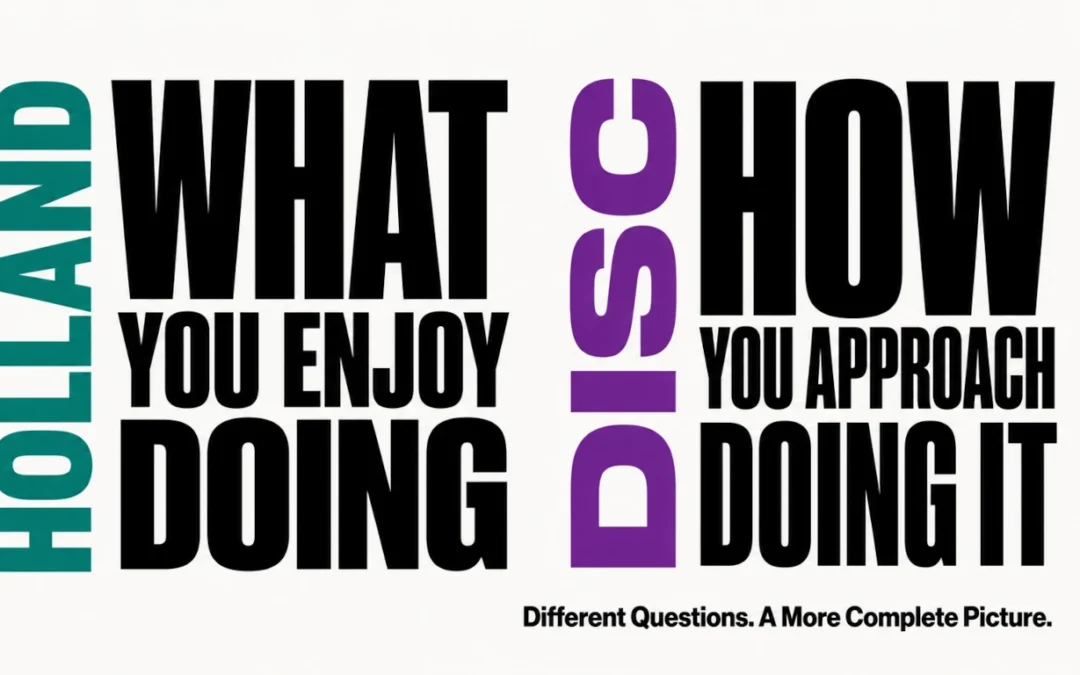
How career interests and behavioral styles reveal different sides of workplace personality.
Personality assessments are often grouped together as though they all measure roughly the same thing.
They do not.
Holland Codes and DISC can both provide useful workplace insight, but they examine different aspects of a person.
Holland Codes focus primarily on interests and preferred work environments.
DISC focuses on observable behavior, communication, pace, and the way someone tends to respond to people and challenges.
Understanding that distinction makes both systems easier to interpret—and more useful when they are considered together.
What Do Holland Codes Measure?
The Holland model, also known as RIASEC, organizes career interests into six broad categories:
These categories help describe the kinds of activities and environments a person may naturally find engaging.
- A Realistic person may enjoy tools, equipment, building, repairing, or hands-on problem solving.
- An Investigative person may be drawn toward research, analysis, diagnosis, and complex questions.
- An Artistic person may value creativity, expression, design, and originality.
- A Social person may enjoy teaching, coaching, helping, and supporting others.
- An Enterprising person may be energized by leadership, persuasion, sales, or launching new initiatives.
- A Conventional person may prefer organization, structure, accuracy, systems, and clearly defined processes.
Most people show a combination of two or three dominant Holland interests rather than fitting neatly into one category.
A Holland profile can help explore questions such as:
- What kinds of work tend to hold this person’s attention?
- Which activities are likely to feel satisfying?
- What type of environment may help this person stay engaged?
- Which parts of a role might eventually feel draining?
Holland Codes are especially useful for career exploration, role alignment, employee development, and understanding motivation.
For a closer look at how the six interests relate to one another, see Understanding the RIASEC Hexagon.
What Does DISC Measure?
DISC describes common behavioral and communication tendencies through four primary styles:
A DISC profile provides clues about how someone may approach work, interact with others, respond to pressure, and move through decisions.
- A High D may be direct, competitive, assertive, and focused on results.
- A High I may be expressive, persuasive, optimistic, and energized by interaction.
- A High S may be patient, supportive, dependable, and attentive to group harmony.
- A High C may be analytical, cautious, precise, and concerned with accuracy.
Most DISC profiles include some degree of all four styles. The pattern, intensity, and relationship between the scores provide more information than assigning someone a single letter.
DISC can help explore questions such as:
- How does this person tend to communicate?
- How quickly are they likely to act?
- What happens when they encounter conflict?
- How much information do they need before making a decision?
- How might they respond to pressure, change, or ambiguity?
That makes DISC useful for communication, leadership, collaboration, conflict management, and understanding workplace behavior.
Holland Codes vs. DISC at a Glance
| Area | Holland Codes | DISC |
|---|---|---|
| Primary focus | Interests, motivation, and preferred work activities | Behavior, communication, pace, and response patterns |
| Core question | What kinds of work may this person enjoy? | How is this person likely to approach the work? |
| Common applications | Career exploration, role alignment, motivation, and employee development | Communication, leadership, teamwork, conflict, and management |
| Categories | Realistic, Investigative, Artistic, Social, Enterprising, and Conventional | Dominance, Influence, Steadiness, and Conscientiousness |
| What it does not establish | Whether someone has the ability or experience required for a job | Whether someone will succeed, perform well, or possess specific technical skills |
The Simplest Way to Understand the Difference
Holland Codes help explain the kinds of work someone may enjoy.
DISC helps explain how they are likely to approach that work.
Consider someone with strong Enterprising interests.
Their Holland profile suggests they may enjoy influencing decisions, leading initiatives, persuading others, or building something new.
Their DISC profile adds another layer.
An Enterprising person with a High D style may pursue those interests through competition, direct action, ownership, and rapid decisions.
An Enterprising person with a High I style may rely more heavily on relationships, enthusiasm, storytelling, and social influence.
Both may enjoy leadership and persuasion. Their day-to-day behavior could look very different.
A Workplace Example
Imagine two employees who both score highly in the Investigative Holland category.
Both enjoy:
- Solving difficult problems
- Analyzing information
- Finding inconsistencies
- Conducting research
- Understanding how systems work
The first employee also has a High C DISC profile.
They may approach investigative work carefully and methodically. They are likely to document their findings, verify assumptions, and avoid drawing conclusions before the evidence feels complete.
The second employee has a High D profile.
They may move through the same problem more aggressively, challenge existing assumptions, reach a conclusion sooner, and push for action based on what they have discovered.
Their Holland profiles point toward a similar source of engagement.
Their DISC profiles help explain the differences in pace, communication, and execution.
Can People With the Same DISC Style Have Different Holland Codes?
Yes—and those differences can be substantial.
Two people may both have High I DISC profiles and appear outgoing, expressive, and comfortable connecting with others.
One may have strong Social Holland interests and enjoy coaching, teaching, or helping people develop.
The other may have strong Enterprising interests and prefer sales, persuasion, negotiation, or business development.
Their behavior may look similar from a distance. Their underlying interests may pull them toward very different roles.
The same is true for every DISC style.
A High C person with strong Conventional interests may enjoy maintaining systems, organizing information, and improving accuracy.
A High C person with strong Investigative interests may be more interested in research, technical analysis, or diagnosing complex problems.
DISC may show how carefully they work. Holland helps clarify what they want to apply that care toward.
Why Employers Use Both
Many hiring and development questions involve more than one dimension.
An employer may need to understand:
- Whether the work itself aligns with a person’s interests
- How the person is likely to communicate
- How they approach decisions
- Whether the pace and structure of the environment suit them
- How they may interact with managers, coworkers, and customers
Holland Codes and DISC contribute different information to that discussion.
A role may contain a strong mix of Enterprising and Social activities because it requires relationship building, persuasion, and leadership.
The same role may benefit from a particular range of DISC behaviors depending on whether the environment requires assertiveness, patience, collaboration, precision, or rapid action.
Neither framework should be treated as a final hiring answer. They are better used to improve interviews, identify areas for discussion, and help managers understand what they may need to support after someone joins the team.
Holland Codes and DISC in Team Development
The same distinction can improve team analysis.
A team’s Holland profile may reveal the kinds of work that collectively energize its members.
A group concentrated in Realistic and Investigative interests may value practical solutions, technical competence, and evidence-based decisions.
DISC may reveal how those team members pursue that work.
A group with many High D members may move quickly, challenge one another, and communicate directly.
A group with more High S and High C members may prefer steadier pacing, careful planning, and clearly defined responsibilities.
Looking at both systems helps explain the team’s work preferences and the behavioral culture that develops around them.
Which Assessment Should You Use?
The answer depends on the question you are trying to explore.
Holland Codes are particularly useful when the conversation involves:
- Career interests
- Motivation
- Role alignment
- Preferred work activities
- Career exploration
DISC is particularly useful when the conversation involves:
- Communication
- Collaboration
- Leadership
- Conflict
- Decision-making
- Behavioral expectations
When the goal is to understand a person more fully, using both provides a broader view.
How Talent Insights Combines Holland Codes and DISC
The Talent Insights MAP assessment combines Holland occupational interests, DISC behavioral tendencies, and 16 Personality communication and decision-making patterns.
Each framework contributes a different perspective:
- Holland Codes explore the work and activities a person may find engaging.
- DISC explores how they tend to behave and interact.
- 16 Personality patterns explore how they may process information, make decisions, and communicate.
Together, these perspectives help employers and individuals ask better questions about hiring, management, development, and team fit.
Learn more in Why Personality Assessments Are More Useful Together Than Alone.
Final Thoughts
Holland Codes and DISC sometimes appear together in lists of personality assessments, but they were designed to examine different parts of the workplace experience.
Holland Codes offer insight into interests, motivation, and preferred activities.
DISC offers insight into behavior, communication, pace, and response patterns.
A person’s interests can tell you where their attention may naturally go. Their behavioral style can help explain what others are likely to experience while working with them.
That combination provides considerably more context than either framework can offer alone.
Explore the complete Personality Types Explained series.
Frequently Asked Questions
What is the main difference between Holland Codes and DISC?
Holland Codes focus on career interests, motivation, and preferred work activities. DISC focuses on behavioral style, communication, pace, decision-making, and how someone tends to interact with other people.
Are Holland Codes and DISC the same kind of personality assessment?
No. They provide different kinds of information. Holland Codes help describe the work and environments a person may find engaging, while DISC helps describe how that person may behave and communicate while doing the work.
Which is better: Holland Codes or DISC?
Neither is universally better. Holland Codes are often more useful for questions about interests, motivation, and career fit. DISC is often more useful for questions about communication, leadership, teamwork, and workplace behavior.
Can two people with the same DISC style have different Holland Codes?
Yes. Two people may behave and communicate similarly while being interested in very different kinds of work. For example, two High I individuals may both enjoy interacting with people, but one may prefer teaching and coaching while the other prefers sales and negotiation.
Do Holland Codes measure skills or ability?
Holland Codes primarily explore interests and preferred activities. They do not establish whether someone possesses the technical skills, credentials, knowledge, or experience required for a particular role.
How can employers use Holland Codes and DISC together?
Employers can use Holland Codes to explore whether the activities within a role align with a candidate’s interests, while DISC can help guide questions about communication, decision-making, collaboration, pace, and management needs.
Hire Better and
Manage Smarter
We combine 3 proven, established assessments into one, giving you the most comprehensive view of a person.
Are you seeking an assessment for personal use? Click Here