
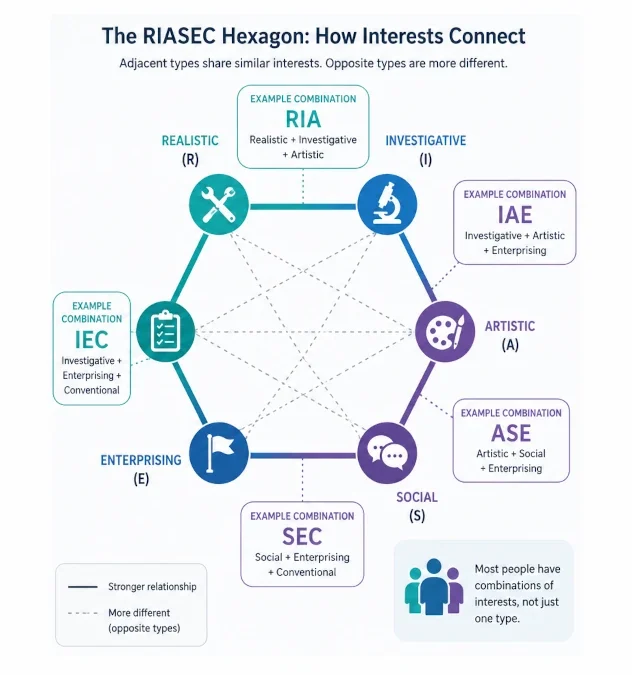
The position of each Holland type on the hexagon is intentional. Types that sit next to one another tend to share similar interests and often appear together in assessment results. Types located farther apart usually represent more different preferences, work environments, and sources of motivation.
That is why the hexagon is useful. It helps explain not only what each Holland type means, but also how different interests can blend together to form more complete three-letter Holland Codes.
| Holland Code Pattern | Common Theme |
|---|---|
| RI | Technical problem solving, tools, systems, and applied analysis |
| IA | Research, ideas, creativity, and original problem solving |
| SE | Helping, teaching, persuading, coaching, and leading others |
| CE | Organization, structure, administration, and operational consistency |
What Is the RIASEC Hexagon?
Psychologist John Holland organized the six interest types into a hexagon to show how closely related they are.
The six types are:
The closer two types are on the hexagon, the more likely they are to share common interests and preferences.
The farther apart two types are, the more different they tend to be.
This simple structure helps explain why some Holland Code combinations appear frequently while others are less common.
Why Adjacent Holland Types Often Appear Together
People rarely fit perfectly into one Holland category.
Instead, most people show a blend of two or three dominant interests.
Realistic + Investigative
Someone with strong Realistic and Investigative interests may enjoy engineering, technical troubleshooting, scientific equipment, or applied problem solving.
They often like both understanding how things work and working directly with them.
Investigative + Artistic
This combination may show up in people who enjoy research, design, innovation, and creative problem solving.
They may like discovering new ideas and expressing them in original ways.
Social + Enterprising
People with strong Social and Enterprising interests may enjoy leadership, coaching, sales, teaching, and motivating others.
They tend to be energized by influencing people, helping people, or both.
Because these types sit near one another on the Holland Hexagon, they often appear together in personality assessments.
Why Opposite Holland Types Are Less Common
Some Holland types represent very different interests.
Realistic vs. Social
Realistic individuals often prefer tools, machinery, hands-on work, and technical environments.
Social individuals often prefer teaching, coaching, helping others, and interpersonal interaction.
A person can certainly have both interests, but those activities tend to pull in different directions.
Investigative vs. Enterprising
Investigative personalities are often drawn toward analysis, research, diagnosis, and discovery.
Enterprising personalities are often drawn toward persuasion, leadership, sales, and influence.
Again, someone may show strengths in both areas. But the interests are not naturally as closely aligned as neighboring types on the hexagon.
What Do Three-Letter Holland Codes Mean?
Most Holland assessments produce a three-letter code rather than a single dominant type.
Examples include:
- RIA
- SEC
- IEC
- ASE
- CRI
The first letter represents the strongest area of interest.
The second and third letters provide additional context and help create a more complete picture.
Example: RIA
A person with an RIA profile may enjoy building, troubleshooting, technical systems, innovation, and scientific thinking.
Example: SEC
A person with an SEC profile may enjoy helping people, leadership, organization, administration, and team coordination.
These combinations often describe workplace preferences more accurately than a single Holland type alone.
Holland Codes and Career Fit
One reason Holland Codes remain useful is that they focus on interests rather than abilities.
The model does not simply ask, “What are you capable of doing?”
It asks a different question: “What kinds of activities naturally energize you?”
Two people may be equally capable of performing the same job. One may find the work highly engaging. The other may find it draining.
Holland Codes help explain some of those differences.
How Employers Use Holland Codes
Organizations often use Holland interests to better understand role fit and workplace engagement.
For example, a role may naturally involve:
- Technical troubleshooting
- Customer interaction
- Leadership responsibilities
- Detailed administrative work
- Creative problem solving
Understanding which Holland interests align with those activities can help employers:
- Benchmark successful employees
- Improve hiring discussions
- Support employee development
- Identify potential role-fit issues
- Build stronger teams
The goal is not to limit opportunities. The goal is to better understand where people are most likely to feel engaged and productive.
How Talent Insights Uses Holland Codes
Within the Talent Insights MAP assessment, Holland Codes provide a valuable layer of information about workplace interests and motivation.
When combined with DISC behavioral styles and 16 Personality communication preferences, organizations gain a broader understanding of:
- What work people enjoy
- How they tend to behave
- How they communicate and make decisions
- Where they may feel most engaged
Together, these perspectives create a more complete picture of workplace fit and development potential.
Final Thoughts
The Holland model is often introduced as six personality types, but the real value comes from understanding how those types interact.
The RIASEC Hexagon helps explain why certain interests naturally cluster together, why most people have multiple dominant interests, and how those combinations influence career preferences.
Understanding your Holland Code will not tell you exactly what career to pursue.
What it can do is provide useful clues about the environments, activities, and challenges that are most likely to keep you engaged over the long term.
Explore the six Holland personality types to learn more about your own RIASEC profile.
Frequently Asked Questions
What is the RIASEC Hexagon?
The RIASEC Hexagon is a visual model showing how the six Holland personality types relate to each other. Types that are closer together on the hexagon tend to share more similarities, while opposite types tend to represent more different interests.
What does RIASEC stand for?
RIASEC stands for Realistic, Investigative, Artistic, Social, Enterprising, and Conventional. These are the six Holland career interest types.
Why do people have three-letter Holland Codes?
Most people are not defined by just one Holland type. A three-letter Holland Code shows a person’s strongest interests in order, giving a more complete picture of their preferred work activities and environments.
What is the difference between adjacent and opposite Holland types?
Adjacent Holland types are located next to each other on the RIASEC Hexagon and often share related interests. Opposite types are farther apart and usually represent more different work preferences.
How can employers use Holland Codes?
Employers can use Holland Codes to better understand role fit, motivation, team composition, and employee development. Holland interests can help explain what kinds of work people are likely to find engaging.
Hire Better and
Manage Smarter
We combine 3 proven, established assessments into one, giving you the most comprehensive view of a person.
Are you seeking an assessment for personal use? Click Here