
Personality Types Explained Series: DISC • Holland • 16 Personalities
What Is a Compressed DISC Profile?
Understanding Flat DISC Results and What They May Mean
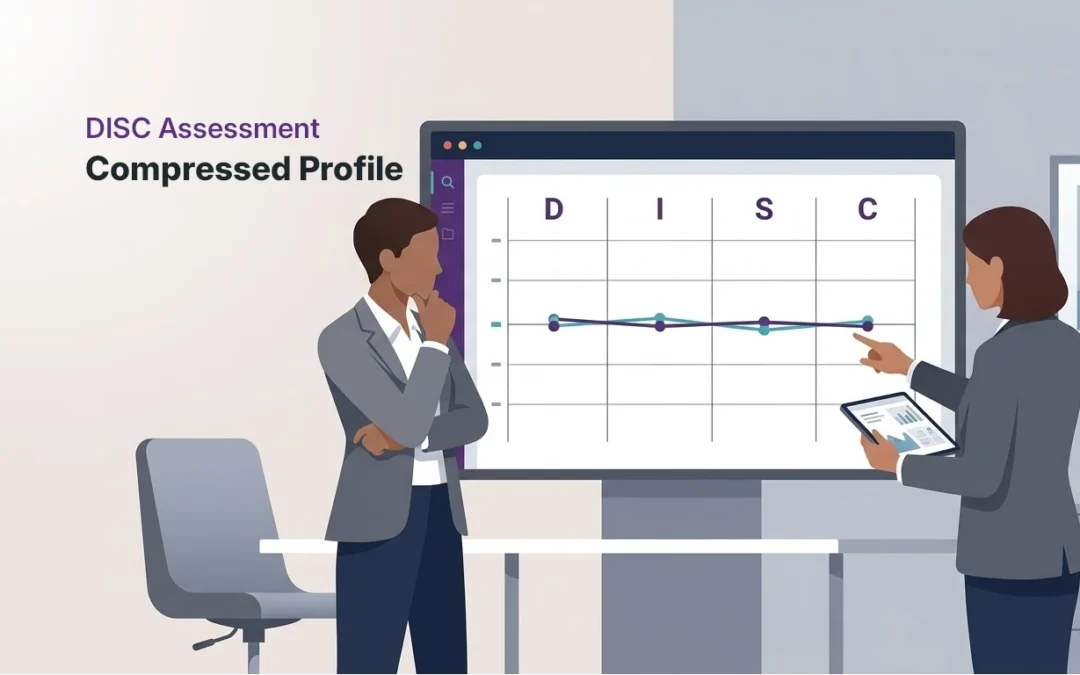
A compressed DISC profile is a DISC assessment result in which the four behavioral dimensions—Dominance, Influence, Steadiness, and Conscientiousness—appear unusually close together or flat. This often suggests that the respondent answered in a highly neutral, inconsistent, overly cautious, or overly idealized way, which can make the assessment less reliable to interpret.
Most DISC results show some visible variation across the four dimensions. People usually have stronger and weaker behavioral tendencies that create a more distinct pattern. When the profile appears very flat or tightly grouped, that can indicate the person’s natural style did not come through clearly in the assessment.
A compressed profile does not necessarily mean anything is “wrong” with the person. It usually means the results should be interpreted with extra caution, and in some cases, the assessment may need to be retaken.
What Does a Compressed DISC Profile Look Like?
In a compressed DISC profile, the scores for D, I, S, and C are all clustered near the middle or are very similar to one another. Instead of showing clear peaks and valleys, the graph appears relatively flat.
That matters because DISC is designed to identify meaningful behavioral patterns. Most people naturally lean more strongly toward some styles than others. A compressed result may make it difficult to determine which tendencies are most natural or most relevant at work.
Quick Summary
| What It Means | The DISC graph appears unusually flat or tightly grouped |
| Common Cause | Neutral, inconsistent, rushed, or overly idealized responses |
| Interpretation Risk | Behavioral style may not be clearly represented |
| What To Do | Review results cautiously and consider retaking the assessment if needed |
| Does It Mean the Person Has No Style? | No—only that the assessment may not have captured it clearly |
Why Compressed DISC Results Happen
There are several common reasons a DISC profile may become compressed.
1. The Person Answered Too Neutrally
Some respondents avoid choosing stronger preferences and instead answer many questions in a moderate or non-committal way. When that happens repeatedly, the assessment may not detect enough contrast to identify a distinct style.
2. The Person Tried to Look “Balanced”
Some people respond based on who they think they should be rather than how they naturally behave. For example, they may try to appear equally strong in leadership, teamwork, caution, and communication. That can flatten the graph and reduce interpretive clarity.
3. The Person Answered Inconsistently
If a respondent changes their frame of reference from question to question, the result may become muddy. They may answer one item based on work, another based on home life, and another based on who they want to become. This inconsistency can produce a compressed profile.
4. The Person Was Distracted or Rushed
Low engagement can also affect accuracy. If someone moves too quickly, multitasks, or does not reflect on the questions carefully, the assessment may not capture a stable pattern.
5. The Person Was Thinking About a Temporary Situation
Sometimes people answer based on a current stressful environment or a role that requires them to behave differently than usual. In that case, the result may reflect temporary adaptation rather than their more natural tendencies.
Does a Compressed Profile Mean the Assessment Failed?
Not necessarily. A compressed profile does not automatically mean the assessment is useless. It means the results may be less definitive and should be interpreted carefully.
In some cases, the report may still offer a few useful insights, especially if one or two dimensions are slightly elevated. But if all four dimensions are tightly grouped and the graph does not show a meaningful pattern, the clearest next step may be to retake the assessment under better conditions.
Can a Compressed Profile Ever Be Genuine?
Yes, occasionally. Some people are highly adaptable, self-controlled, or context-sensitive, and they may not express strong preferences in obvious ways. Even so, truly flat DISC profiles are less common than profiles with clearer variation.
That is why many organizations treat a compressed profile as a signal for caution rather than as a final conclusion about personality.
What Should Someone Do If They Get a Compressed DISC Profile?
Retake the Assessment if Appropriate
If the result appears unusually flat and does not feel accurate, retaking the assessment can be a good idea. It is best to do so when the person is focused, not rushed, and answering based on their natural workplace behavior rather than an idealized self-image.
Answer Based on Typical Behavior
Respondents should think about how they usually behave, especially in work settings, rather than how they behave on their best day, worst day, or in a highly unusual situation.
Avoid Trying to “Game” the Assessment
DISC is most useful when answered honestly. Trying to look balanced, impressive, or universally capable often reduces the quality of the result.
Use Additional Context
If the assessment remains somewhat compressed, managers or coaches may want to interpret it alongside interviews, observation, and other assessment tools rather than relying on the DISC graph alone.
How Compressed Results Affect Workplace Interpretation
DISC is often used to understand communication style, work pace, leadership tendencies, and team dynamics. A compressed profile makes those insights less clear because the usual behavioral patterns do not stand out as strongly.
For example, a clear DISC profile might suggest that someone prefers direct communication, careful analysis, steady support, or relationship-driven persuasion. A compressed profile makes it harder to determine which of those tendencies is most natural.
That does not mean the person has no personality style. It means the assessment may not have captured it clearly enough to support confident interpretation.
How Talent Insights Handles a Compressed Profile
In the Talent Insights MAP assessment, a compressed DISC profile is treated as a signal that the assessment may not have captured the respondent’s behavioral pattern clearly. This can happen when the person responds too neutrally, inconsistently, or in a way that does not reflect their natural tendencies.
When that occurs, the result should be reviewed carefully. In some cases, retaking the assessment may provide a more useful and interpretable pattern.
Related DISC Guides
Frequently Asked Questions
What is a compressed DISC profile?
A compressed DISC profile is a result in which the four DISC dimensions are very close together, making the graph appear relatively flat. This can reduce the clarity of the interpretation.
Why are my DISC scores all similar?
This can happen if you answered neutrally, inconsistently, too quickly, or based on who you think you should be rather than how you naturally behave.
Does a compressed DISC profile mean something is wrong with me?
No. It usually means the assessment may not have captured your behavioral tendencies clearly enough for strong interpretation. It reflects the quality of the response pattern, not your worth or ability.
Should I retake a DISC assessment if my profile is compressed?
If the result seems unclear or inaccurate, retaking the assessment under calmer and more focused conditions is often a good idea.
Can someone genuinely have a compressed DISC profile?
Sometimes, yes. But strongly compressed results are less common than profiles with clearer variation, so they are usually interpreted with caution.
Hire Better and
Manage Smarter
We combine 3 proven, established assessments into one, giving you the most comprehensive view of a person.
Are you seeking an assessment for personal use? Click Here