
Personality Types Explained Series: DISC • Holland • 16 Personalities
INTP Personality Type: The Thinker
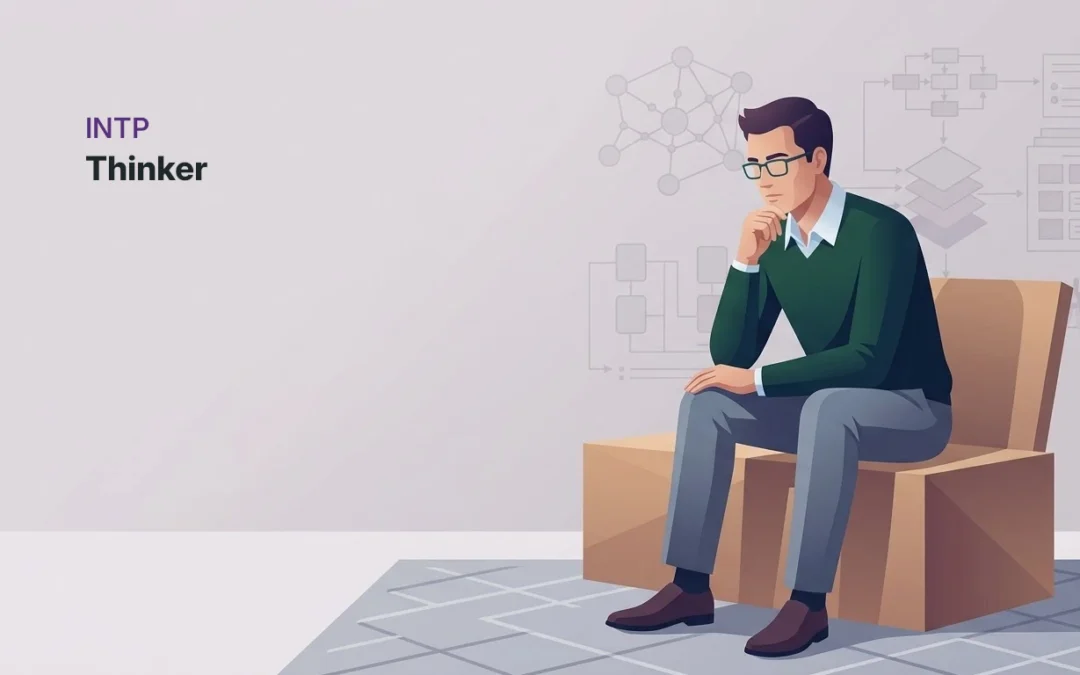
The INTP personality type—often called The Thinker—is defined by curiosity, analysis, and a deep desire to understand how things work. INTPs are driven by ideas and systems, often exploring concepts at a level others may overlook.
In the workplace, INTPs are the ones asking, “Why does this work this way?”—and then building a better model.
What Does INTP Stand For?
- I – Introversion: Prefers focused, independent work
- N – Intuition: Seeks patterns, concepts, and abstract relationships
- T – Thinking: Uses logic and objective reasoning
- P – Perceiving: Prefers flexibility, exploration, and open-ended thinking
Together, these traits create a personality that is analytical, inventive, and highly independent in thought.
Core Traits of the INTP Personality
1. Deeply Analytical
INTPs naturally break problems down into their components. They enjoy understanding systems at a fundamental level and identifying underlying principles.
2. Concept-Driven
They are more interested in ideas than immediate execution. INTPs often explore multiple possibilities before settling on a conclusion.
3. Independent Thinkers
INTPs prefer forming their own frameworks rather than adopting existing ones without question.
4. Curious and Open-Ended
They tend to keep options open, continuously refining their understanding as new information emerges.
Strengths of INTPs in the Workplace
- Strong analytical and problem-solving ability
- Creative and innovative thinking
- Ability to work independently on complex challenges
- Comfort with abstract and theoretical concepts
- Willingness to question assumptions and improve systems
Potential Blind Spots
- May delay decisions while exploring possibilities
- Can struggle with routine or repetitive tasks
- May appear disengaged in highly structured environments
- Communication may be overly abstract or technical
With clear expectations and practical boundaries, INTPs can translate ideas into meaningful outcomes.
Best Career Paths for INTPs
INTPs thrive in roles that involve analysis, theory, and problem-solving.
- Software development and engineering
- Data science and analytics
- Research and academia
- Systems design and architecture
- Strategy and innovation roles
INTPs in Hiring and Management
How INTPs Perform in Structured Interviews
INTPs tend to perform best when interview questions allow them to explain their reasoning. They excel when given opportunities to demonstrate problem-solving and conceptual thinking.
Working with INTPs on a Team
To get the best from an INTP:
- Allow space for independent thinking
- Focus on problems rather than rigid processes
- Encourage them to share insights and ideas
- Provide flexibility in how work is completed
Work Style
INTPs prefer autonomy and intellectual challenge. They are most engaged when solving meaningful problems rather than following predefined routines.
How Talent Insights Helps You Understand INTPs
Talent Insights helps identify INTP tendencies as part of a broader personality profile, including DISC and Holland Code dimensions.
- Benchmark candidates for analytical and problem-solving roles
- Compare multiple candidates objectively
- Use structured interviews to evaluate reasoning consistently
- Build teams that balance thinkers with executors
This approach ensures INTP strengths are applied where deep thinking and innovation are most valuable.
Related Personality Types
Final Thoughts
INTPs bring curiosity, logic, and innovation to organizations. When given the freedom to explore ideas and solve complex problems, they can uncover insights that lead to meaningful improvements.
Hire Better and
Manage Smarter
We combine 3 proven, established assessments into one, giving you the most comprehensive view of a person.
Are you seeking an assessment for personal use? Click Here