

Hiring isn’t just about finding good people. It’s about placing good people in the right roles.
Where the “Bus” Metaphor Comes From
Jim Collins, in Good to Great, popularized a simple leadership metaphor:
- “Who” before “what” — get the right people first, then decide where to drive.
- The right people — character traits like discipline and integrity can’t be trained into someone later.
- The right seats — strong people still need the right roles to thrive.
- Wrong people off — misaligned hires can damage culture and performance over time.
Collins’ point wasn’t that strategy doesn’t matter. It was that strategy is irrelevant without the right people to execute it.
And even the right people can struggle if they’re placed in the wrong roles.
This article focuses on that final idea: how structured candidate comparison helps ensure strong people are placed in the right seats.
Good vs. Better Aligned
Most hiring decisions don’t come down to good versus bad.
They come down to good versus better aligned.
You have two capable candidates.
Both meet the qualifications.
Both interview well.
Both could succeed.
So the real question isn’t:
“Will this person fail?”
It’s:
“Which person is best aligned to this specific role?”
It’s not enough to put good people on the bus. The real leverage comes from putting strong people in seats where their inherent traits allow them to thrive.
The Scenario: Leading an Outside Sales Team
Let’s look at a real example.
The role: Leader of an outside sales team.
The job description calls for someone who can:
- Drive energy and momentum
- Lead people through pressure
- Stay resilient in fast-paced environments
- Maintain enough structure to prevent operational drift
Two candidates rise to the top:
- Michelle Thompson
- Sylvia Martinez
Both are strong. Both meet the requirements. Both could perform well.
Now the decision becomes strategic, not corrective.
How We Generated the Comparison
To make the trade-offs easier to see, we used the Talent Insights Candidate Comparison tool. It summarizes each candidate’s potential strengths and potential challenges against the defined role context so hiring teams can compare two strong candidates side by side.
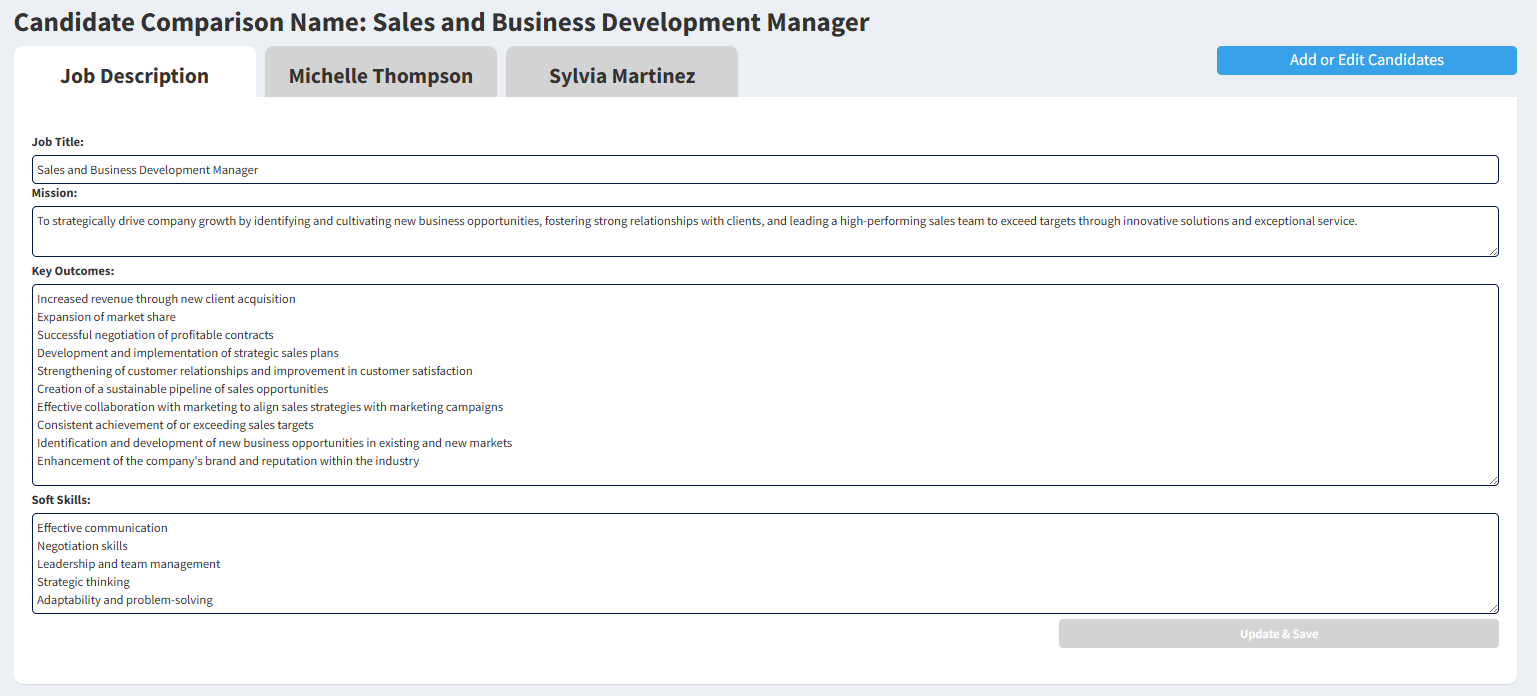
Job Description
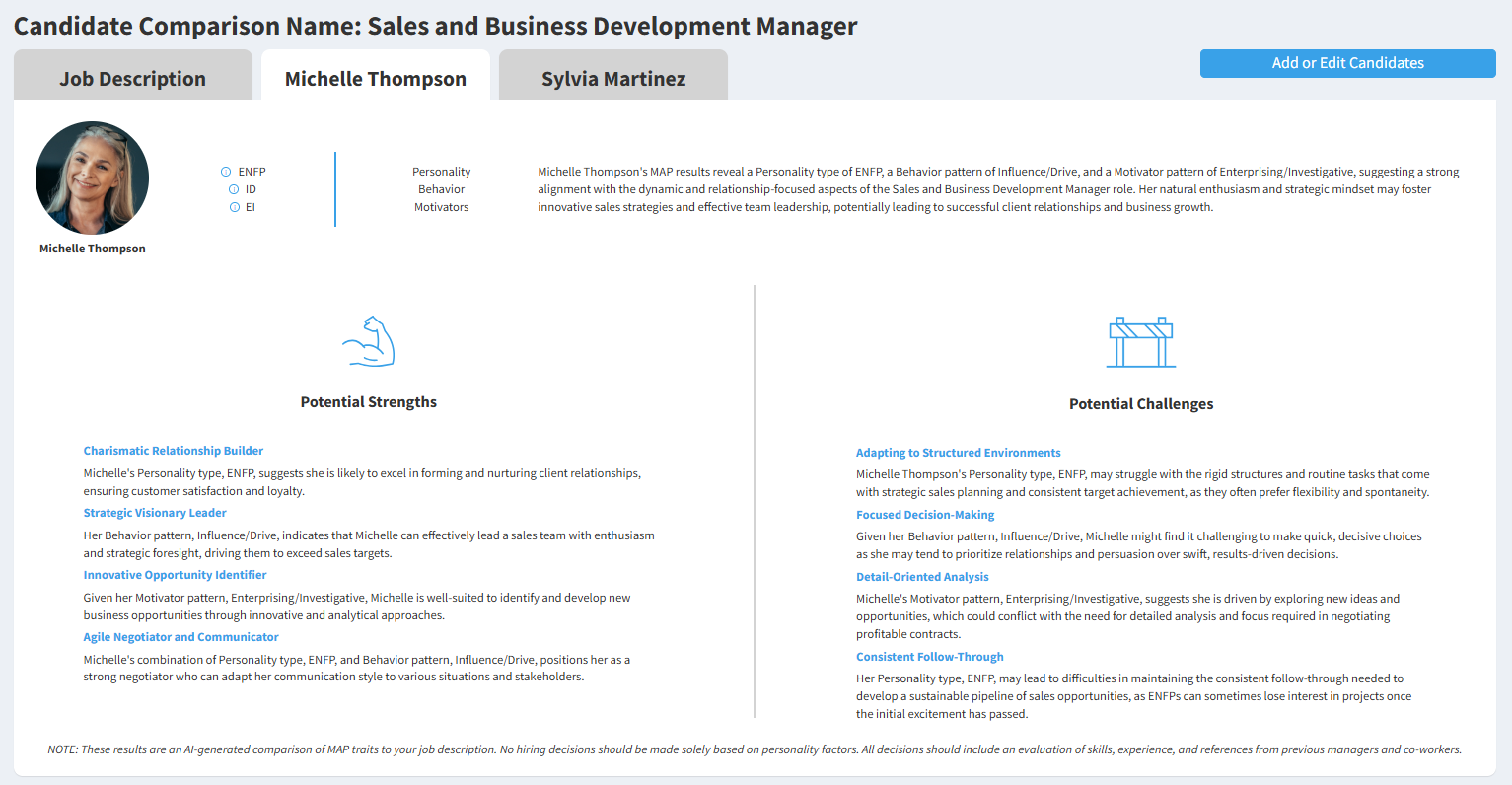
Michelle Thompson
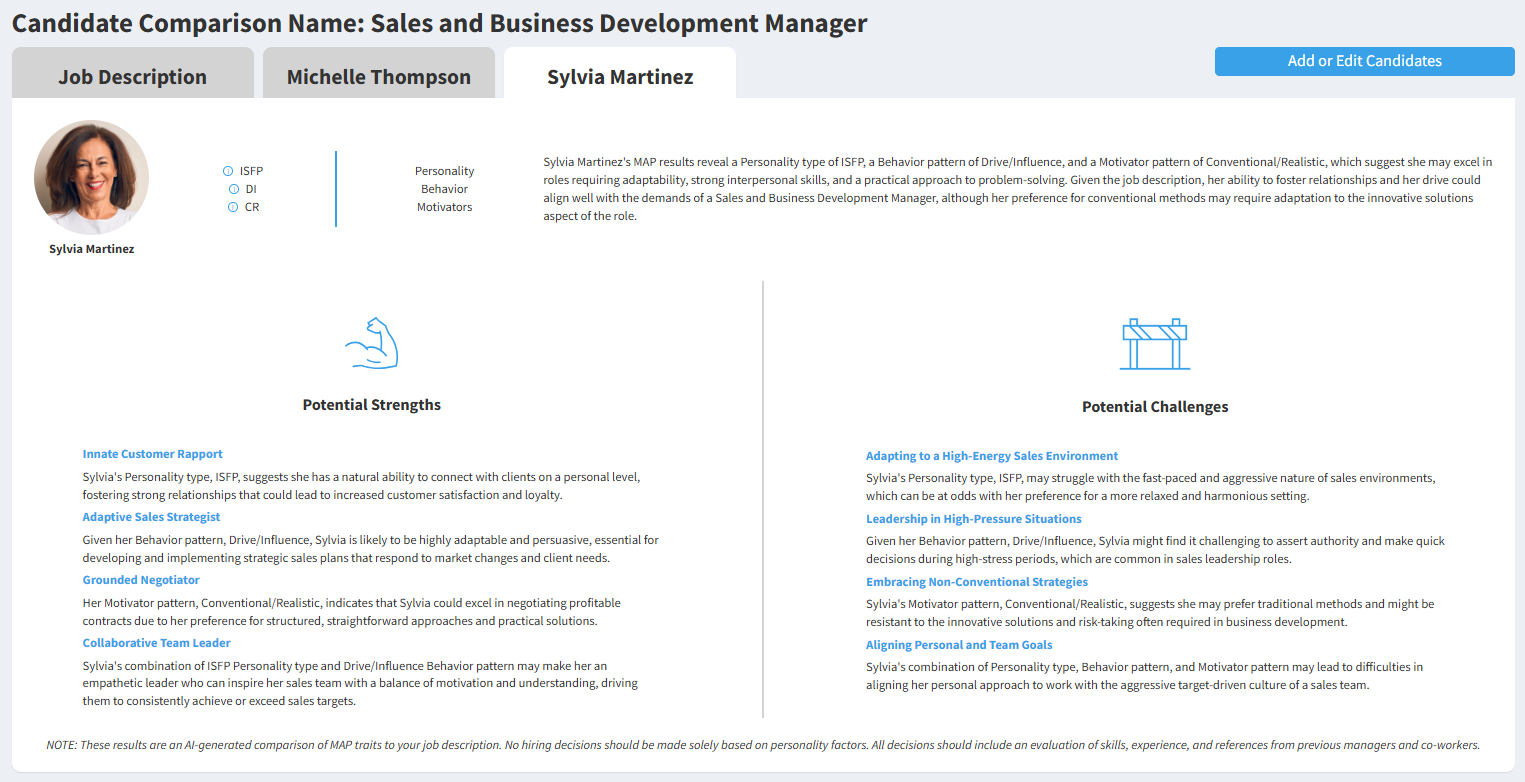
Sylvia Martinez
The goal isn’t to replace judgment. It’s to support it—so the final decision is clearer, easier to explain, and easier to defend.
Michelle: The Momentum Driver
Michelle’s strengths align strongly with outward-facing sales leadership.
Strengths
- Energized by persuasion and influence
- Comfortable driving performance through others
- Naturally assertive and competitive
- Thrives in dynamic, outward-facing roles
Michelle brings visible energy to the bus. She accelerates it.
Challenges
- May become bored with extended analysis
- May struggle with consistency and operational detail
In the right seat—leading a fast-moving outside sales team—her traits create lift.
In the wrong seat—managing long-cycle account detail or compliance-heavy oversight—those same traits could create friction.
Michelle is not simply “a strong candidate.” She is strong in motion.
Sylvia: The Stability Anchor
Sylvia presents a different—but equally valuable—profile.
Strengths
- Highly consistent
- Strong follow-through on details
- Methodical and reliable
- Maintains standards under structure
Sylvia stabilizes the bus. She keeps it aligned and steady.
Challenges
- May experience stress in highly volatile, pressure-heavy environments
In a major account manager role—where consistency, relationship depth, and follow-through matter—Sylvia’s traits would likely compound over time.
In a high-velocity, constant-pressure sales leadership role, she may expend more energy managing stress than driving growth.
Sylvia is not less capable. She is differently wired.
The Seat Determines the Outcome
Without structured comparison, hiring conversations might sound like:
- “Michelle feels more dynamic.”
- “Sylvia seems more dependable.”
- “Michelle has stronger energy.”
- “Sylvia is more consistent.”
All true. None decisive.
Structured comparison reframes the discussion:
- What does this role actually require?
- Which inherent traits align most directly with that requirement?
- Where are the trade-offs?
- Which challenges are tolerable in this seat—and which are not?
The bus matters. But the seat matters more.
Traits vs. Skills
Skills can be trained. Traits are more durable.
If the role demands:
- Momentum under pressure
- Comfort with ambiguity
- Outward-facing drive
Then Michelle’s traits align more directly.
If the role demands:
- Consistency
- Detail management
- Relationship stability
Then Sylvia’s traits may create stronger long-term outcomes.
Neither candidate is “better.” But one is better aligned to a specific seat.
What Structured Comparison Actually Does
Structured candidate comparison:
- Aligns evaluation to defined role criteria
- Surfaces trade-offs explicitly
- Prevents charisma from overshadowing consistency
- Prevents experience length from defaulting to the tie-breaker
Instead of asking:
“Who do we like more?”
You ask:
“Which candidate’s inherent traits are most aligned with the success profile of this role?”
That shift changes the quality of the decision.
Avoiding Over-Engineering
Some organizations respond to comparison challenges by building overly complex scoring systems.
That often creates a new problem: analysis without clarity.
Effective candidate comparison should be:
- Clear
- Repeatable
- Explainable
- Defensible
If the hiring team cannot articulate why Candidate A is better aligned than Candidate B in a few clear sentences, the framework is either too vague—or too complex.
The goal is alignment, not arithmetic.
What This Means for Your Hiring Process
When you:
- Define the role clearly
- Understand the inherent traits required
- Evaluate candidates consistently
- Compare strengths and challenges side by side
You don’t just make good hires. You make aligned hires.
And aligned hires compound.
- They experience less friction.
- They require less corrective management.
- They produce more sustainable performance.
The Takeaway: Comparison Is Where Great Hiring Happens
Resumes screen.
Assessments inform.
Structured interviews evaluate.
Comparison determines alignment.
Better hiring isn’t just about avoiding mistakes. It’s about consciously placing strong people in roles where they can perform at their best.
The bus matters. But the seat determines the outcome.
FAQ: Candidate Comparison for Better Hiring Decisions
Updated for 2026.
If both candidates are strong, can the decision still be “wrong”?
If both candidates are strong, the decision is unlikely to be a “bad hire.” The risk is misalignment—placing a capable person into a seat that doesn’t match their inherent traits. That can reduce performance and increase friction over time.
What’s the difference between “good vs. bad” and “good vs. aligned”?
Good vs. bad focuses on screening out poor fits. Good vs. aligned focuses on choosing which strong candidate best matches the specific demands of the role—pace, pressure, leadership style, and day-to-day work requirements.
How do we compare candidates objectively without overcomplicating it?
Use a consistent set of role criteria, evaluate each candidate against the same framework, and summarize strengths and challenges side by side. The goal is a clear, explainable rationale—not an elaborate scoring model.
What inputs should be included in a candidate comparison?
The strongest comparisons combine multiple signals: baseline qualifications (resume), behavioral tendencies (assessments), and applied evidence (structured interviews). Together, they make trade-offs easier to see and discuss.
How should we handle trade-offs between candidates?
Trade-offs are normal. Instead of trying to find a “perfect” candidate, identify which strengths are essential for success in that seat, which risks are acceptable, and which risks would create ongoing friction in the role.
Does structured comparison remove human judgment?
No. Structured comparison supports human judgment by making the decision clearer and more defensible. It replaces vague impressions with transparent criteria and documented trade-offs.
Why does “seat on the bus” alignment matter so much?
Because traits are durable. Skills can be trained, but traits like pace tolerance, follow-through, comfort with pressure, and leadership tendencies shape how someone performs day to day. The right seat allows strengths to compound; the wrong seat creates friction.
Sources & Additional Reading
Hire Better and
Manage Smarter
We combine 3 proven, established assessments into one, giving you the most comprehensive view of a person.
Are you seeking an assessment for personal use? Click Here