
Personality Types Explained Series: DISC • Holland • 16 Personalities
Holland Code Personality Types Explained
RIASEC Career Interests and the Work Environments People Naturally Prefer
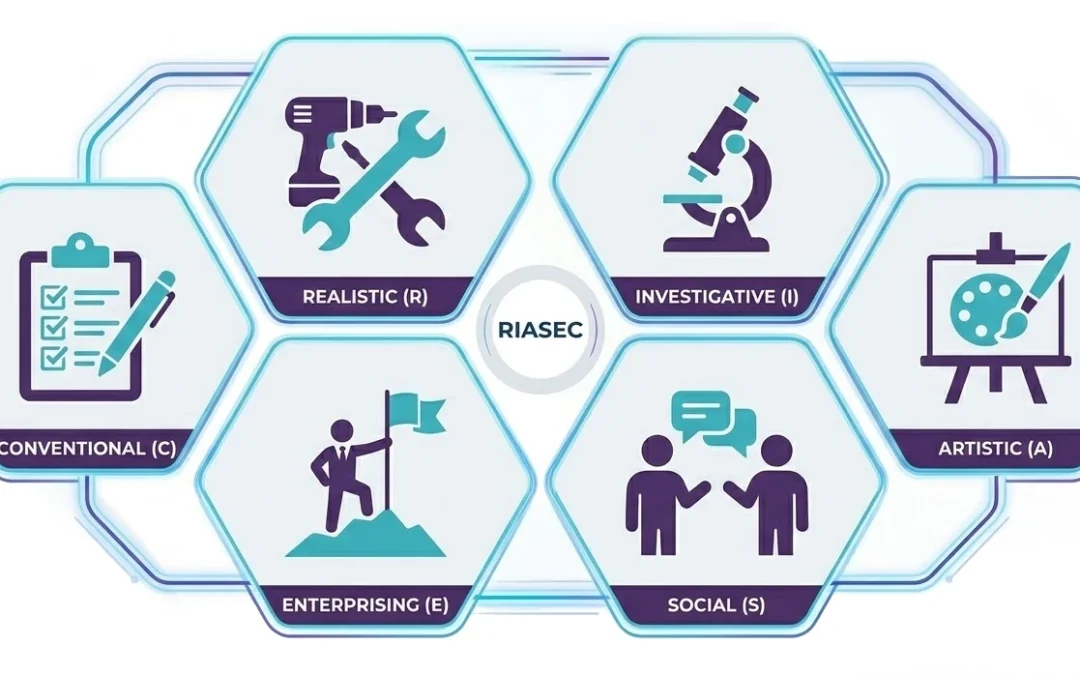
Holland Code personality types, also called RIASEC career interests, describe the kinds of work environments people are naturally drawn toward. The six Holland environments are Realistic, Investigative, Artistic, Social, Enterprising, and Conventional. Together, they help explain what kinds of activities, roles, and workplace settings are likely to feel most energizing and satisfying.
The Holland Code model is one of the most widely used frameworks for career exploration and vocational fit. Rather than focusing only on personality traits, it looks at the kinds of work people naturally enjoy and the environments where they are most likely to thrive.
In the Talent Insights MAP assessment, Holland interests help identify the types of work settings and activities a person may find most engaging. This can be useful for career guidance, hiring decisions, role fit, and employee development.
What Are Holland Code Personality Types?
The Holland model groups career interests into six broad work environments. These are often referred to by the acronym RIASEC:
- R – Realistic
- I – Investigative
- A – Artistic
- S – Social
- E – Enterprising
- C – Conventional
Most people are not limited to just one Holland type. Instead, they usually show a combination of two or three dominant interests, which helps create a more complete picture of the environments and work styles they prefer.
Quick Summary of the Six Holland Types
| Code | Environment | Core Theme |
| R | Realistic | Hands-on problem solving |
| I | Investigative | Analytical thinking and research |
| A | Artistic | Creative expression and originality |
| S | Social | Helping, teaching, and supporting others |
| E | Enterprising | Leading, persuading, and influencing |
| C | Conventional | Organization, structure, and systems |
How Holland Codes Work
Holland Codes are designed to match people with the kinds of work environments that fit their interests. The idea is simple: people tend to be more satisfied and effective when their work environment aligns with what naturally interests them.
For example, someone with strong Investigative interests may enjoy research, analysis, or scientific problem solving, while someone with strong Enterprising interests may prefer leadership, sales, or entrepreneurial work.
Many people have a three-letter Holland Code, such as RIA, SEC, or IEC. These combinations create more specific patterns of interest and help describe how multiple work preferences come together.
The Six Holland Work Environments
Practical, hands-on individuals who often enjoy tools, machinery, building, fixing, and physical problem solving.
Curious, analytical individuals who often enjoy research, science, diagnosis, and solving complex intellectual problems.
Creative, expressive individuals who often enjoy design, writing, art, and work that allows originality and self-expression.
People-oriented individuals who often enjoy helping, teaching, coaching, and supporting the growth of others.
Persuasive, energetic individuals who often enjoy leading, influencing, selling, and building initiatives.
Organized, detail-oriented individuals who often enjoy systems, administration, data, and structured work processes.
Why Holland Codes Matter at Work
Holland Codes help explain why certain jobs and environments feel energizing for some people and draining for others. Two people can both be competent in a role, but only one may feel truly engaged by the day-to-day nature of the work.
Understanding Holland interests can help with:
- career exploration
- role alignment
- hiring fit
- employee development
- job satisfaction
- team composition
This framework is especially useful because it focuses on what people are naturally interested in doing, not just what they are capable of doing.
How Talent Insights Uses Holland Codes
The Talent Insights MAP assessment combines Holland occupational interests with DISC behavioral tendencies and 16 personality patterns to provide a broader understanding of how people work.
Within MAP, Holland Codes help identify the kinds of work environments and activities a person may find most engaging. This adds an important layer to hiring, coaching, and team-fit decisions.
By using multiple frameworks together, organizations can gain a more practical picture of:
- what kind of work a person naturally enjoys
- how they tend to behave in the workplace
- how they think, decide, and communicate
How Employers Use Holland Codes in Hiring
While Holland Codes are often used for career exploration, they can also be a powerful tool for hiring and team alignment.
Instead of guessing whether a candidate will thrive in a role, employers can use personality data to compare how closely a candidate’s natural interests align with the job itself.
- Define the ideal profile for a role using RIASEC traits
- Compare candidates side-by-side against that benchmark
- Identify strengths and gaps before making a hiring decision
This approach helps reduce bias and brings more consistency to hiring decisions.
See how this works in practice:
Use our Multi-Assessment Profile (MAP) to apply Holland Codes, DISC, and 16 Types together in hiring.
Related Personality Guides
Frequently Asked Questions
What are Holland Codes used for?
Holland Codes are used to understand the kinds of work environments and activities a person is naturally interested in. They are widely used in career guidance, education, hiring, and role-fit assessment.
What does RIASEC stand for?
RIASEC stands for Realistic, Investigative, Artistic, Social, Enterprising, and Conventional—the six Holland career interest environments.
Can someone have more than one Holland type?
Yes. Most people show a combination of two or three dominant Holland interests rather than only one.
How do Holland Codes help with hiring?
They can help organizations understand whether a role’s work environment is likely to match a person’s natural interests, which may improve engagement and fit.
Hire Better and
Manage Smarter
We combine 3 proven, established assessments into one, giving you the most comprehensive view of a person.
Are you seeking an assessment for personal use? Click Here