
Interest in hiring assessments is rising sharply — so sharply, in fact, that it is now approaching the same level of public interest as personality assessments themselves.
This shift shows up plainly in Google Trends, where search volume for “hiring assessment” has steadily climbed for the last several years and is now converging with “personality assessment,” a category that once outpaced it dramatically.
The result is a striking picture: what was once a niche, sometimes controversial hiring practice is fast becoming mainstream.
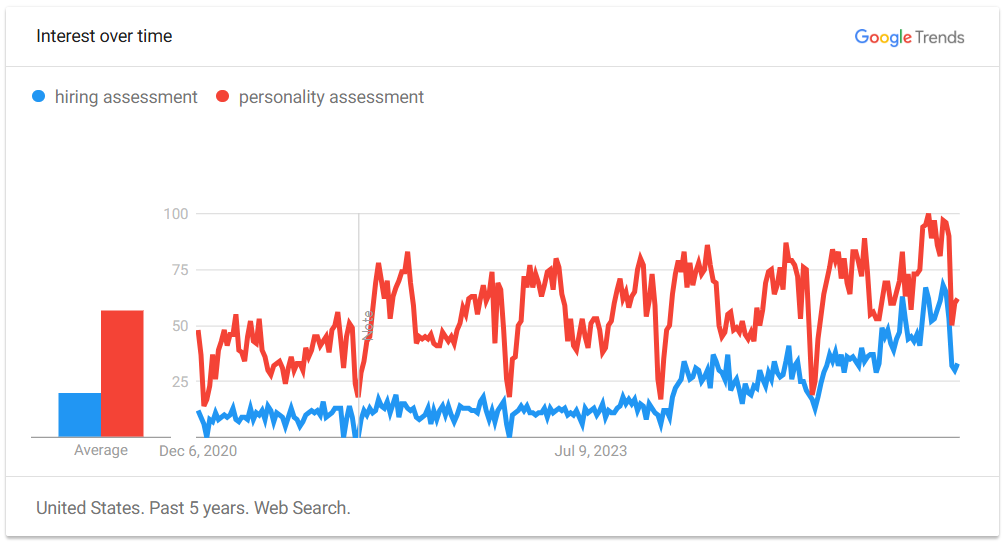
Google search interest for ‘hiring assessment’ (blue) and ‘personality assessment’ (red), U.S., 2020–2025.
This article explores the data behind that shift, the reasons driving it, and what it means for companies trying to hire more effectively in 2026 and beyond.
1. The Data: Hiring Assessments Are Surging in Popularity
A five-year Google Trends comparison between “hiring assessment” and “personality assessment” shows three major patterns:
Hiring assessments are on a sustained, upward trajectory.
- Search interest has risen almost every year since 2020.
- There is a noticeable acceleration beginning around 2022.
- This is not a short-term anomaly — it’s a clear trend.
The gap between the two terms is narrowing.
- For years, personality assessments generated far more search interest than hiring assessments.
- Today, the two are much closer than they used to be.
- In some weeks of 2024–2025, hiring assessments even approach or exceed personality assessment interest in certain regions.
Both terms show a predictable seasonal pattern.
- December: major dip in search volume.
- January: fast rebound.
- June: strong seasonal peak in overall job search activity.
This gives us two key insights:
- Companies and candidates both reduce activity in December.
- Assessment interest is strongly tied to hiring cycles, particularly in Q1.
Taken together, the data paints a clear picture: hiring assessments have moved from the margins into the mainstream of HR decision-making.
But the next question is even more important: why now?
2. Why Hiring Assessments Are Rising: Four Forces Behind the Shift
The growth in hiring assessments reflects deeper changes in how companies hire, how employees expect to be evaluated, and how work itself has evolved since 2020.
Below are the four major drivers behind the trend.
Post-Pandemic Hiring Chaos Created Demand for Structure
From 2020 to 2023, hiring conditions were volatile:
- Entire industries shut down, then reopened suddenly.
- Remote hiring became standard almost overnight.
- Candidate expectations shifted in profound ways.
- Turnover surged and retention became harder.
- Managers struggled to evaluate fit through virtual interviews.
- Many companies experienced waves of short-tenure hires.
This exposed significant flaws in traditional hiring practices:
- Too much intuition and “gut feeling.”
- Too little consistency across candidates and roles.
- No reliable method to evaluate communication styles.
- Limited insight into cultural or motivational fit.
HR leaders began asking a critical question: “How do we make hiring decisions that hold up under pressure?”
Hiring assessments — once optional — became essential. They offered structure, fairness, and repeatability at a moment when everything else felt unstable.
Soft Skills and Emotional Intelligence Became Critical
Even before the pandemic, soft skills were rising in importance. Afterwards, they became non-negotiable.
Reports like LinkedIn’s Global Talent Trends have repeatedly listed soft skills — communication, collaboration, leadership, adaptability — as top priorities for talent professionals.
As AI increasingly takes on the less complex, more repeatable tasks being done by the workforce, companies will need to hire talent who have broader, uniquely human skills. We’re seeing increasing demand for skills like problem-solving, adaptability, and collaboration – skills that spur organizational agility.
— Erin Scruggs: LinkedIn VP and head of global talent acquisition
Hybrid and remote work magnified this need:
- Communication breakdowns became more common.
- Managers struggled to interpret interpersonal cues from behind a screen.
- Teams needed clarity about work preferences and communication styles.
- Conflict resolution required more awareness and intentionality.
Hiring based on technical skills alone no longer works.
Assessments such as DISC, MBTI, or Holland Code offer insight into:
- Communication preferences.
- Motivational drivers.
- Work style and decision-making patterns.
- Leadership tendencies.
- Team compatibility and potential friction points.
As companies realized these traits directly impact team performance, assessments naturally moved toward the center of the hiring process.
HR Is Under Pressure to Show Fair, Defensible Hiring Practices
Another trend fueling the rise of hiring assessments is the growing expectation of fairness, documentation, and defensibility in hiring.
Multiple forces are at play:
- Increased legal and regulatory scrutiny.
- More emphasis on reducing bias and improving equity.
- Pressure from executives for more consistent hiring outcomes.
- Candidates expecting transparency in how they are evaluated.
- Boards and leadership teams demanding stronger people analytics.
Simply put: “gut feeling” is no longer an acceptable hiring strategy.
Assessments support:
- Structured evaluation criteria.
- Documented justification for decisions.
- Comparable candidate data.
- Reduced subjectivity in panel discussions.
- Better alignment across hiring managers and stakeholders.
They help companies demonstrate that hiring decisions are based on meaningful, job-related factors.
Personality Assessments Have Gone Mainstream
The final driver is cultural. Over the last decade, interest in personality frameworks has exploded.
People voluntarily take:
- DISC.
- MBTI.
- Enneagram.
- StrengthsFinder.
- VIA Character Strengths.
- Big Five and other trait-based tools.
- Countless lightweight quizzes on social media.
These tools have become part of everyday language at work and in life.
This matters because employees no longer view assessments as intimidating or intrusive. They see them as:
- Interesting.
- Insightful.
- Helpful for teamwork.
- A tool for growth and self-awareness.
The stigma that once surrounded hiring assessments has faded. Familiarity has built comfort — and comfort enables adoption.
We’ve reached a point where both HR professionals and job candidates expect some level of structured evaluation in a modern hiring process.
3. What These Trends Mean for Companies Heading Into 2026
The rise in hiring assessment interest isn’t just an academic insight — it has real implications for how organizations should operate as they prepare for the year ahead.
Here are five of the most important takeaways for 2026.
Unstructured Hiring Is Becoming a Strategic Risk
Inconsistent interviews lead to inconsistent hires.
Without structure:
- Bias increases.
- Fit is unpredictable.
- Hiring decisions feel arbitrary.
- Misalignment creates problems later in the employee lifecycle.
Assessments help anchor evaluations in shared language and comparable metrics, reducing risk and increasing clarity.
Soft Skills Are Now a Central Hiring Criterion
Technical skills may get someone in the door. Soft skills determine whether they succeed and stay.
Assessment data is extremely valuable early in the hiring funnel — not merely as a late-stage validation step.
Hiring Managers Need Better Tools to Understand Fit
Teams thrive when people understand:
- How each other communicates.
- How decisions are made.
- How conflicts arise and get resolved.
- What motivates or drains each team member.
Assessments help reveal these factors before a hiring decision is made, giving managers a clearer sense of how a candidate will mesh with existing team dynamics.
Better Hiring Decisions Lead to Better Retention
Companies are discovering that assessment-driven hiring reduces:
- Culture misalignment.
- Onboarding friction.
- Manager-employee conflict.
- Short-tenure turnover.
A hiring process that understands the whole person — not just the résumé — leads to more sustainable placements.
Candidates Expect a Modern, Professional Experience
Assessments communicate that a company is:
- Serious about hiring well.
- Committed to fairness and clarity.
- Invested in understanding people, not just filling seats.
This is increasingly important for employer brand and overall candidate experience.
4. How Talent Insights Fits into the Trend
The rise of hiring assessments isn’t slowing — and companies need tools that are:
- Scientifically grounded.
- Fast and easy to use.
- Rich in insight, without being overwhelming.
- Affordable for mid-sized teams.
- Practical in real hiring conversations.
- Useful for long-term team development, not just selection.
This is where Talent Insights is positioned uniquely well.
Talent Insights offers:
- A unified approach combining DISC, MBTI, and Holland Code for a multi-dimensional view of each person.
- Clear, practical hiring recommendations that hiring managers can actually use.
- Benchmarking tools to define role expectations and compare candidates against ideal profiles.
- Candidate comparison tools that make side-by-side evaluation easier and more objective.
- Structured Interview Guides that connect assessment insights directly to interview questions.
- Team Insights reports for new hire onboarding and leadership development.
- Interaction Guides for better communication and management between leaders and team members.
As hiring teams embrace structured evaluation in 2026, Talent Insights provides the clarity, depth, and practicality they need.
Conclusion: 2026 Is the Year Assessments Become Standard in Hiring
The data is clear:
- Interest in hiring assessments is rising.
- The gap with personality assessments is narrowing.
- HR leaders want more structure, fairness, and insight in their hiring processes.
- Soft skills and communication preferences are more important than ever.
- Companies are investing in tools that make hiring more predictable and aligned.
What used to be a fringe practice is now expected.
Hiring assessments are not just “a trend” — they have become a core component of modern, people-centered hiring.
And as organizations prepare for a new year, the shift couldn’t be better timed.
If you’re exploring how to strengthen your hiring process in 2026, now is the perfect time to see what modern assessment tools can do.
Hire Better and
Manage Smarter
We combine 3 proven, established assessments into one, giving you the most comprehensive view of a person.
Are you seeking an assessment for personal use? Click Here